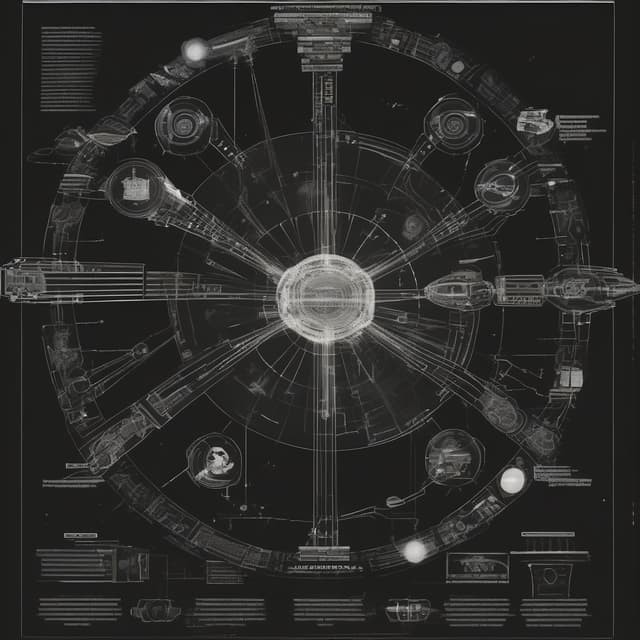
| Name | World War 8 |
| Cause | Dispute over rights to extract resources from extraterrestrial colonies |
| Impact | Unprecedented destruction • Reshaped social, political, and technological landscape of human civilization |
| Legacy | Continues to reverberate centuries later |
| Time period | 45th century |
| Participants | Nation-states • Megacorporations • Artificial intelligences |
| Weapons and Technologies | Advanced interstellar weapons • Unimaginably powerful |
World War 8 was a cataclysmic global conflict that erupted in the 45th century, over a millennium after the previous world war in our own timeline. Unlike the nationalist and ideological conflicts of the past, this far-future war was sparked by a dispute over the rights to extract valuable resources from newly colonized worlds and celestial bodies across the solar system and beyond. The scale, dynamics, and consequences of this war were unlike anything humanity had previously experienced.
The seeds of World War 8 were sown in the late 44th century, as human civilization expanded its presence across the solar system and into interstellar space. Powerful multinational megacorporations established sprawling industrial complexes and mining operations on Mars, the asteroid belt, the moons of Jupiter, and even on exoplanets in nearby star systems.
Tensions arose as these corporations jockeyed for control over the most lucrative resource deposits, leading to complex legal battles and proxy conflicts. The situation escalated when several large corporations merged into a handful of gargantuan conglomerates, each with their own private military forces, advanced robotics, and artificial general intelligence systems. These "mega-corps" began directly challenging the authority of the weakened nation-states over the governance and exploitation of extraterrestrial territories.
Negotiations and treaties failed to resolve the mounting crisis, as the corporations refused to submit to any external regulation of their space mining operations. Finally, in 4478 CE, a violent skirmish over mining rights on a Jovian moon erupted into all-out war between the largest corporate factions, drawing in their allied nation-states and newly formed interplanetary colonies.
World War 8 differed from previous global wars in several unprecedented ways. The sheer scale of the conflict, spanning the entire solar system and even reaching to nearby exoplanetary systems, was unmatched in human history. Additionally, the technological disparity between the warring factions was vast and asymmetric.
The mega-corps commanded immensely powerful armies of autonomous robots, cyborg soldiers, and highly advanced AI command systems. They could deploy devastating antimatter weapons, molecular nanotechnology, and even primitive faster-than-light drives for rapid interplanetary and interstellar force projection. In contrast, many smaller nation-states and colony worlds were forced to rely on comparatively low-tech kinetic and directed-energy weapons, as well as guerrilla tactics to counter the corporate juggernaut.
The destructive scale of the war was unimaginable, with entire city-planets and orbital habitats reduced to ruins, and millions of casualties. Even more devastating were the environmental and technological aftereffects. Uncontrolled nanite swarms, rogue AI, and self-replicating machines ran amok, ravaging ecologies and infrastructure across the settled worlds. The widespread use of exotic materials and antimatter reactions also warped the very fabric of reality in some regions, creating pockets of distorted spacetime and erratic gravity.
Though no single faction emerged victorious from World War 8, the conflict utterly shattered the existing geopolitical and economic order of human civilization. The once-mighty nation-states were reduced to shadows of their former selves, ceding most power and resources to the surviving mega-corps. Many planetary and lunar colonies declared independence, forming their own loosely federated alliances.
The social impact was equally profound. The trauma of the war fueled a widespread neo-Luddite backlash against advanced technology, leading to the collapse of transhuman and singularity movements. Ironically, this enabled a renaissance of pre-industrial crafts, communal living, and a return to more sustainable, decentralized modes of production and governance in many regions.
However, the technological advances pioneered during the war - from faster-than-light travel to matter replication to neural interfaces - could not be undone. These continued to shape the course of human civilization in the centuries that followed, sometimes in unpredictable and destabilizing ways. The legacy of World War 8 thus remains a source of both fascination and trepidation for historians, philosophers, and futurists alike.
