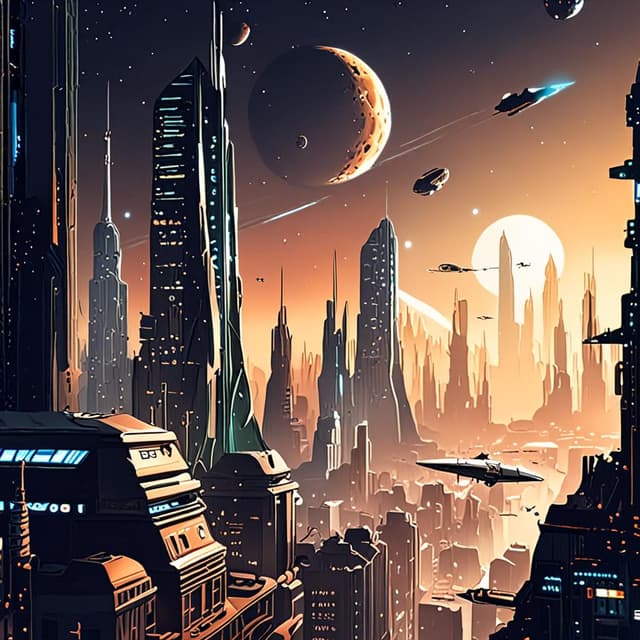
| Summary | In this alternate timeline, the communist vision of the 'withering away of the state' is realized through dramatic advances in space exploration and astronautics, rather than traditional Marxist-Leninist revolutionary processes. Inspired by the science fiction of Polish author Stanislaw Lem, this unique interpretation of a stateless, post-scarcity global civilization fundamentally reshapes the political and social trajectory of the 20th and 21st centuries. |
| Inspiration | Stanislaw Lem's science fiction stories set in the Magelanic Clouds |
| Key outcome | Stateless, post-scarcity global civilization |
| Transition process | Enabled by advancements in space exploration and astronautics, rather than Marxist-Leninist revolution |
In this alternate timeline, the Marxist concept of the "withering away of the state" - the idea that the state will gradually dissolve as communist society emerges - takes on a dramatically different form than in our own history. Rather than unfolding through the revolutionary processes envisioned by figures like Karl Marx and Vladimir Lenin, the transition towards a stateless, post-scarcity global civilization in this timeline is heavily inspired by the visionary science fiction writings of Polish author Stanislaw Lem.
Lem's influential series of novels and stories set in the Magelanic Clouds, a pair of nearby dwarf galaxies, depict a future in which humanity has largely transcended the need for traditional nation-states and centralized governmental structures. Instead, these tales envision a sprawling, decentralized interstellar civilization marked by hyper-advanced astronautics, nanotechnology, and automation.
In Lem's vision, the challenges of exploring and colonizing the remote Magelanic Clouds serve as a catalyst for the dissolution of rigid geopolitical borders and top-down power structures. As humans push outward into the stars, they are forced to embrace more flexible, cooperative, and technologically-enabled modes of social and political organization. Nation-states give way to vast, semi-autonomous habitats, space habitats, and mobile "cloud cities" that drift between the Clouds.
Lem's science fiction proved enormously influential, not just in the realm of literature but in shaping the political and social trajectories of this alternate timeline. Dissident groups, futurists, and even mainstream communist theorists latched onto the Magelanic Cycle's vision of a "withering away of the state" - but one achieved not through proletarian revolution, but rather through the transformative power of space exploration and advanced technology.
The space race between the United States and the Soviet Union in this timeline takes on a very different character, driven more by the pursuit of interstellar colonization and resource extraction than Cold War geopolitical rivalry. Astronauts and cosmonauts become the vanguard of this new era, tasked with building the decentralized "cloud cities" and habitats that will come to replace the nation-state model.
As the 20th century progresses, the technological capabilities unleashed by this space-enabled transition - including nanotechnology, artificial general intelligence, and post-scarcity economics - accelerate the withering away of the state even further. Traditional nation-states crumble in the face of these sweeping changes, replaced by a complex web of self-governing, technologically-empowered communities that span the globe and beyond.
By the mid-22nd century, humanity has largely achieved the communist dream of a "withering away of the state" - not through violent revolution, but rather through the transformative power of space exploration and technological utopianism. The world has become a vast, decentralized civilization of semi-autonomous cloud cities, space habitats, and hyper-efficient resource-sharing networks. Scarcity has been largely eliminated, and the old ideologies of nationalism and centralized state power have been consigned to the dustbin of history.
Of course, this transition has not been without its challenges and growing pains. Critics argue that the new order, while more equitable and prosperous, has also become stagnant and bureaucratic in its own way. The loss of traditional cultural and political identities has also bred a nostalgic backlash in some quarters. But overall, this unique interpretation of the "withering away of the state", drawn from the visionary sci-fi of Stanislaw Lem, has fundamentally reshaped the human condition in this alternate timeline.
