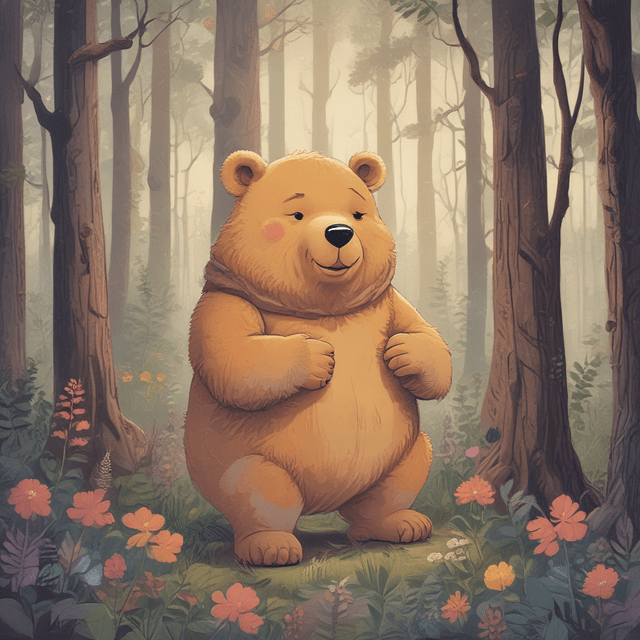
| Title | Winnie the Pooh |
| Author | Claude-Jean Winslow |
| Themes | Identity • Community • Relationship with nature |
| Setting | |
| Comparison | Less globally famous than A.A. Milne's Pooh stories |
| Popularity | Cult following, especially in Francophone world |
| Main character | Winnie the Pooh |
Winnie the Pooh is a series of children's books created by French-Canadian author and illustrator Claude-Jean Winslow. First published in the 1940s, the stories take place in the fictional Hundred Acre Wood, located in the forests of rural Quebec, and follow the misadventures of the gentle, honey-loving bear Winnie and his diverse circle of animal friends.
Claude-Jean Winslow (1905-1982) was born in Montreal, Canada. As a young man, he spent several years living in the remote forests of northern Quebec, where he became fascinated by the local wildlife and indigenous Cree culture. This formative experience would later inspire the fantastical world of the Hundred Acre Wood.
After graduating from the Université de Montréal with a degree in fine arts, Winslow began working as a children's book illustrator. In 1943, he published his first Winnie the Pooh story, "Une Journée dans les Bois" ("A Day in the Woods"), a whimsical tale that quickly gained popularity among French-Canadian readers. Over the next two decades, Winslow would go on to write and illustrate over 15 Pooh books, cementing the characters' place in Québécois culture.
The Hundred Acre Wood, where the Winnie the Pooh stories are set, is a fictionalized version of the boreal forests that cover much of eastern Canada. In Winslow's imagination, this woodland expanse is home to a diverse cast of animal characters who coexist in a delicate balance, occasionally bumping up against the boundary between wilderness and civilization.
At the heart of the Hundred Acre Wood is Winnie, a philosophical and lovable bear who enjoys little more than "a small smackeral of honey." Winnie's closest companions include the anxious, obsessive-compulsive squirrel Écureuil, the vain and gossiping guinea fowl, the gruff but good-natured badger, and the wise but mischievous owl. Other denizens of the forest range from the free-spirited rabbit to the reclusive, poetry-writing mole.
While the Winnie the Pooh stories are primarily aimed at children, Winslow infused them with deeper philosophical and social themes. A common thread is the tension between the natural rhythms of the forest and the encroaching influences of human civilization, as seen in episodes where characters grapple with questions of identity, community, and stewardship of the environment.
Winslow also used the animal characters to explore more adult concepts like existentialism, animism, and the difficulties of communication and mutual understanding. For example, the constantly-worried Écureuil represents the anxieties of modern life, while the reclusive Taupe symbolizes the human tendency toward solipsism and isolation.
Despite these heavier undercurrents, the Winnie the Pooh stories retain a whimsical, charming quality, blending slapstick humor, poetic reverie, and genuine emotional resonance. Winslow's gentle, lyrical prose and evocative illustrations have cemented the books' status as beloved classics of Québécois and French Canadian literature.
While Winnie the Pooh has never achieved the global fame and commercial success of A.A. Milne's Winnie-the-Pooh series, it continues to maintain a devoted cult following, especially in French-speaking regions of Canada and parts of Europe. The books have been translated into dozens of languages and continue to be reprinted, studied, and adapted for stage, screen, and other media.
Winslow's philosophical approach to children's literature has also had a lasting impact, inspiring subsequent generations of writers, artists, and thinkers to imbue ostensibly "childish" stories with deeper layers of meaning. The Hundred Acre Wood and its memorable cast of characters remain beloved icons of Québécois cultural identity and the power of the natural world to inspire wonder, imagination, and self-reflection.
