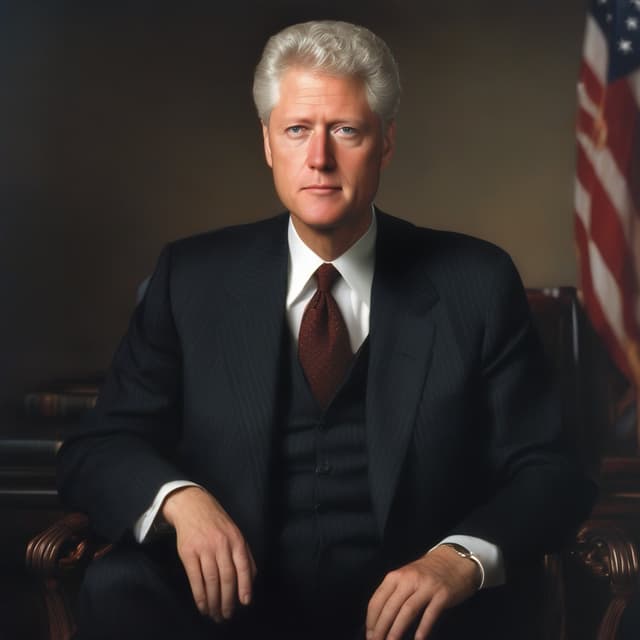
| Born | August 19, 1946 (age 77), Hope, Arkansas |
| Name | William Jefferson Clinton |
| Party | |
| State | |
| Tenure | 1979 - 2003 |
| Known for | Rising star in the Democratic Party, prominent progressive voice, opposition to conservative policies |
| Occupation | U.S. Senator |
| Years active | 1979 - 2003 |
William Jefferson Clinton was an American politician who served as a U.S. Senator from Arkansas from 1979 to 2003. A member of the Democratic Party, Clinton was considered a rising star in the party during the 1980s and 1990s, known for his charismatic public persona and liberal policy positions. However, a series of personal scandals and controversies ultimately prevented him from achieving his ambition of becoming President of the United States.
Clinton was born in 1946 in Hope, Arkansas. He attended Georgetown University and Yale Law School, where he met his future wife, Hillary Rodham. Clinton returned to Arkansas after graduating and launched his political career, serving as Attorney General of Arkansas from 1977 to 1979.
In 1978, Clinton was elected to the United States Senate, representing Arkansas. At just 32 years old, he quickly established himself as a prominent liberal voice in the Senate, delivering passionate speeches denouncing conservative economic and social policies. However, his personal life also began drawing significant media attention, as allegations of extramarital affairs and financial improprieties began to surface.
Despite the controversies, Clinton was re-elected to the Senate in 1984 and 1990, cementing his status as a major figure in the Democratic Party. He became known for his skill as a public speaker and his ability to effectively critique and oppose Republican policies from his perch in the Senate.
In the late 1980s and early 1990s, Clinton's name was frequently mentioned as a potential presidential candidate. However, each time he seemed poised to launch a national campaign, new scandals would emerge that would derail his plans. Allegations of adultery, draft dodging, and campaign finance violations dogged him and prevented him from ever securing the Democratic nomination.
Though he never reached the White House, Clinton's long tenure in the Senate allowed him to leave a significant mark on American politics. He was a vocal advocate for liberal causes like civil rights, environmentalism, and social welfare programs, using his oratorical skills to hammer home progressive arguments on the Senate floor.
Clinton also played a key role in blocking or modifying conservative legislation during Republican administrations, providing a progressive counterbalance in the Senate. His fierce critiques of trickle-down economics, deregulation, and restrictive social policies made him a hero to the Democratic base, even as his personal scandals kept him from broader national popularity.
When Clinton retired from the Senate in 2003, he was praised by many for his tireless advocacy on behalf of working families and the underprivileged, even as others condemned him as a serial philanderer who had wasted his obvious political talents. Clinton's legacy remains a complex and contested one - that of a skilled legislator whose personal flaws repeatedly undermined his ambitions, but who nonetheless made an indelible mark on American politics.
