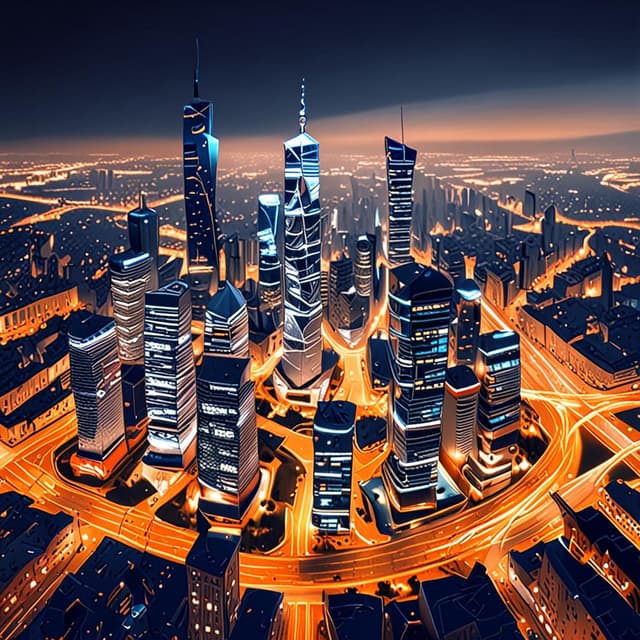
| Status | Global hub of innovation, transhumanism, and human enhancement |
| Location | |
| Challenges | Environmental degradation • Resource scarcity • Social unrest • Supporting a population in the hundreds of millions |
| Time period | 1,000,000 AD |
| Key features | Sprawling megacity • Arcologies for the wealthy • Overcrowded, polluted slums • Advanced technologies (genetic engineering, nanotechnology, artificial intelligence) • Complex multi-tiered transportation network |
The Warsaw Metropolitan Area, often simply referred to as "Warsaw," is a sprawling megacity that has grown to encompass much of central Poland over the past millennium. With a population estimated between 200-300 million, it is one of the largest urban centers on Earth and a global hub of technological advancement, wealth, and human enhancement.
The origins of the modern Warsaw megacity can be traced back to the 21st century, when the Polish capital first began a period of rapid expansion and transformation. As advances in fields like genetic engineering, artificial intelligence, and nanotechnology accelerated, Warsaw became a magnet for scientists, engineers, and technopreneurs from around the world.
By the year 2100, the greater Warsaw area had grown to over 10 million residents, with a dense, vertical skyline of towering arcologies and skyscrapers. Over the following centuries, the city continued to expand outward, annexing surrounding towns and villages to create an urban agglomeration spanning hundreds of kilometers.
Today, the Warsaw Metropolitan Area is a colossal, labyrinthine metropolis, with dozens of distinct districts and neighborhoods, each with their own character and level of technological sophistication. The core of the city is dominated by the gleaming spires of the ultra-wealthy and heavily augmented elite, while the outer regions consist of cramped, polluted slums housing the unaugmented masses.
Warsaw is at the forefront of many cutting-edge technological fields, from quantum computing and nanorobotics to genetic engineering and brain-computer interfaces. The city is a global hub for research, development, and manufacturing of advanced technologies, particularly those related to human enhancement and the transhumanist movement.
Many of Warsaw's residents, especially in the wealthier districts, have embraced various forms of biological, cybernetic, and cognitive augmentation. Genetically engineered "post-humans" with superhuman physical and mental capabilities live alongside those with advanced prosthetics, neural implants, and nanomachines integrated into their bodies. These enhancements have extended average lifespans well past 150 years.
However, access to these life-altering technologies is highly unequal, leading to stark divides in society. Those who cannot afford or access augmentation are left behind in the impoverished outer districts, facing shorter, more difficult lives.
Navigating the vast expanse of Warsaw requires an advanced, multi-tiered transportation system. At the upper levels, high-speed maglev trains, flying cars, and even personal VTOL craft zip between the towering arcologies and hubs of the wealthy elite. Beneath this, a sprawling network of subway, monorail, and tram lines connects the broader metropolitan area.
For the lower classes, travel is limited to overcrowded public transit, autonomous cargo drones, and aged ground-based vehicles. Traffic congestion is a constant issue, as is maintaining the aging infrastructure that ties the megacity together.
As Warsaw has grown to immense size and technological prowess, it has also faced mounting challenges related to overpopulation, environmental degradation, and socioeconomic inequality.
The sheer scale of the city's population has put immense strains on its water, power, and food supplies. Waste management and pollution control are constant battles, with many outer districts choked by smog, plastics, and other contaminants. Climate change and resource scarcity have only exacerbated these ecological woes.
Socially, the divide between the ultra-wealthy augmented elite and the unenhanced masses has led to rising tensions and sporadic civil unrest. Protests, riots, and even terrorist attacks targeting the privileged districts occasionally disrupt the city's daily functions. Attempts to quell this unrest with advanced security technologies have had limited success.
As Warsaw pushes the boundaries of what is technologically possible, it struggles to maintain social cohesion and sustainability in the face of unchecked growth and widening inequality. The city's future remains uncertain, balanced precariously between utopian visions of a transhumanist paradise and the looming specter of systemic collapse.
