| Name | Warsaw |
| Role | Political center • Economic center • Cultural center |
| Type | Capital city |
| Country | |
| Landmarks | Old Town of Warsaw • Royal Castle in Warsaw • Warsaw Uprising Monument • Palace of Culture and Science |
| Population | 1.8 million (city), 3.1 million (metro area) |
| Established | 13th century |
| Key Industries | Finance • IT • Business services • Tourism |
Warsaw is the capital and largest city of the Polish Republic, serving as a political, economic, and cultural center for the country. As the seat of the Polish government and home to numerous universities, research institutes, and multinational corporations, Warsaw is a major hub of activity and influence within both Poland and the broader European continent.
The origins of Warsaw can be traced back to the 10th century, when a small settlement known as Warszawa first emerged along the banks of the Vistula River. Over the following centuries, the town grew in size and importance, eventually becoming the seat of the Dukes of Mazovia in the 13th century.
Warsaw's strategic location and its status as a regional administrative center led to its selection as the capital of the Polish-Lithuanian Commonwealth in 1569. This marked the beginning of a golden age for the city, as it underwent extensive urbanization and architectural development under the patronage of successive Polish monarchs.
Unlike in our timeline, Warsaw was able to maintain its position as the undisputed capital of Poland throughout the 19th and early 20th centuries, despite the machinations of its expansionist neighbors. This was largely due to the outcome of the Polish-German War of 1905-1908, which resulted in the establishment of an independent Kingdom of Poland.
In the aftermath of this conflict, Warsaw experienced a period of rapid industrialization and modernization, transforming into a major European metropolis. The city's population grew exponentially, and it became a hub of cultural, intellectual, and scientific activity, earning it the nickname the "Paris of the North."
Today, Warsaw is one of the most prosperous and influential cities in Europe. As the seat of the Polish government and home to numerous multinational corporations, the city is a crucial economic engine, contributing significantly to the country's overall GDP.
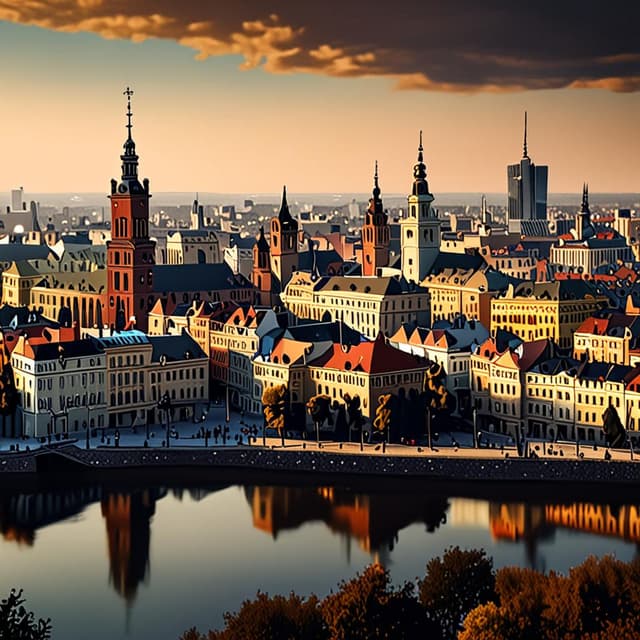
Warsaw's skyline is dominated by a mix of historic architecture and modern skyscrapers, reflecting its unique blend of tradition and progress. The city is renowned for its vibrant cultural scene, with world-class museums, theaters, and performing arts venues that draw visitors from around the world.
In addition to its political and economic significance, Warsaw also serves as an important educational and research hub. The city is home to several prestigious universities, including the University of Warsaw, as well as numerous scientific institutes and think tanks that contribute to Poland's technological and innovative prowess.
Despite the challenges of rapid urbanization and the need to balance preservation with development, Warsaw has managed to maintain its character and identity as a quintessentially Polish city. Its residents take great pride in the city's rich history and its role as the beating heart of the Polish nation.
As the 21st century unfolds, Warsaw continues to evolve and adapt, solidifying its position as one of the most dynamic and influential cities in Europe. Its combination of historic charm, modern amenities, and innovative spirit ensures that it will remain a vital part of Poland's future for generations to come.
