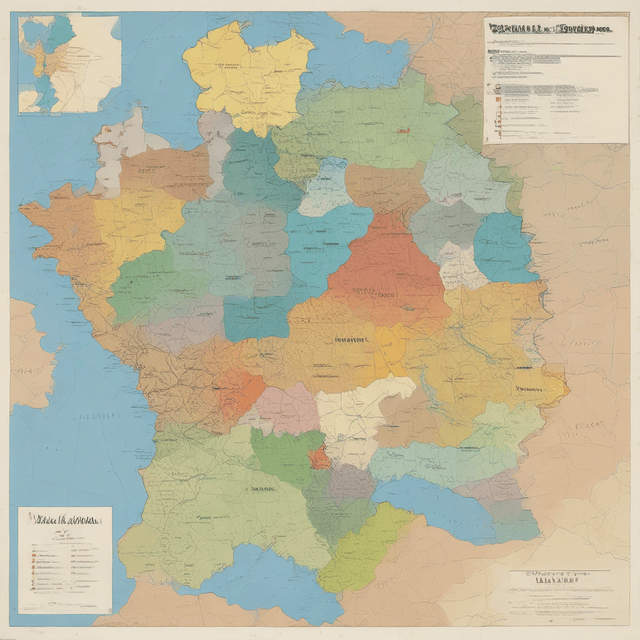
| Name | Wallonia |
| Type | Independent nation |
| Status | Independent and autonomous within Europe, influential economic and cultural force |
| Borders | |
| Culture | French-influenced |
| Economy | Coal production • Steel production • Chemical production |
| History | Emerged from shifting European empires and kingdoms, established independence in 17th century |
| Location | Southern Benelux region |
Wallonia is an independent nation located in the southern half of the Benelux region of Western Europe, sharing borders with France, the Netherlands, and the German States. Wallonia has a distinct French cultural and linguistic identity, though it has been influenced by its neighbors over the centuries. As one of the earliest industrialized regions of Europe, Wallonia played a pivotal role in the Industrial Revolution and remains an important economic and political force today.
The origins of Wallonia can be traced back to the late medieval period, when the region was part of a patchwork of territories under the rule of various European powers, including the Kingdom of France, the Holy Roman Empire, and the Duchy of Burgundy. In the 17th century, as these larger empires weakened, Wallonia gradually coalesced into a distinct political and cultural entity.
In 1653, the region formally declared independence and established the Kingdom of Wallonia, with its capital in the city of Namur. This new nation successfully navigated the shifting alliances and conflicts that characterized 17th and 18th century Europe, maintaining its sovereignty despite repeated attempts by its neighbors to either conquer or absorb it.
Wallonia covers an area of 16,844 square km (6,510 square miles) in the southern part of the Benelux region. The terrain is mostly rolling hills and river valleys, with the Ardennes forest covering much of the eastern part of the country. The climate is temperate, with cool, wet winters and mild summers.
The population of Wallonia is approximately 4.2 million as of 2020. The vast majority, around 90%, speak French as their first language, with the remaining 10% speaking various Dutch and German dialects. Wallonia's largest city and economic center is Liège, followed by Charleroi, Namur, and Mons.
Wallonia was one of the first regions in continental Europe to industrialize, with the process beginning in the late 17th century. Aided by abundant natural resources like coal and iron ore, as well as a well-developed network of rivers and canals, Wallonia quickly became a hub of coal mining, steel production, and chemical manufacturing.
Key innovations that fueled Wallonia's industrial growth included:
By the mid-19th century, Wallonia had become one of the most industrialized regions in Europe, rivaling even England. This rapid economic transformation, however, also sowed the seeds of political upheaval.
Wallonia's path to independence and its subsequent political development were marked by periodic revolutions, regime changes, and conflicts with neighboring powers. In 1686, the kingdom overthrew its Burgundian monarch in favor of a parliamentary system inspired by the Dutch Republic. This Walloon Revolution set the stage for further political reforms in the 18th and 19th centuries.
In 1789, Wallonia experienced its own version of the French Revolution, establishing a short-lived Republic of Wallonia. This was followed by a period of French occupation and attempts at integration into the French Empire. Wallonia ultimately reasserted its independence in 1815 after the Napoleonic Wars, adopting a constitutional monarchy.
The late 19th and early 20th centuries saw Wallonia buffeted by the competing ambitions of its larger neighbors - Germany, France, and the Netherlands. However, the kingdom managed to maintain its autonomy, often by playing these powers off against each other. A series of political reforms in the 1930s transitioned Wallonia into a modern parliamentary democracy.
Today, Wallonia remains an independent nation within the broader European Union, wielding significant economic and political influence. Its industries, including steel, chemicals, and advanced manufacturing, continue to be major drivers of the European economy. Wallonia is also a leader in fields like renewable energy and environmental protection.
Culturally, Wallonia has a strong French identity, with a vibrant artistic scene, distinctive cuisine, and the widespread use of the French language. However, the country also embraces its multilingual heritage, with Dutch and German minorities playing an important role in public life.
As Wallonia navigates the challenges of the 21st century, it does so as a proudly independent nation that has carved out a unique space for itself within the web of European powers. Its history of industrialization, political turmoil, and hard-won autonomy have forged a distinct Walloon identity that continues to shape the region's trajectory.
