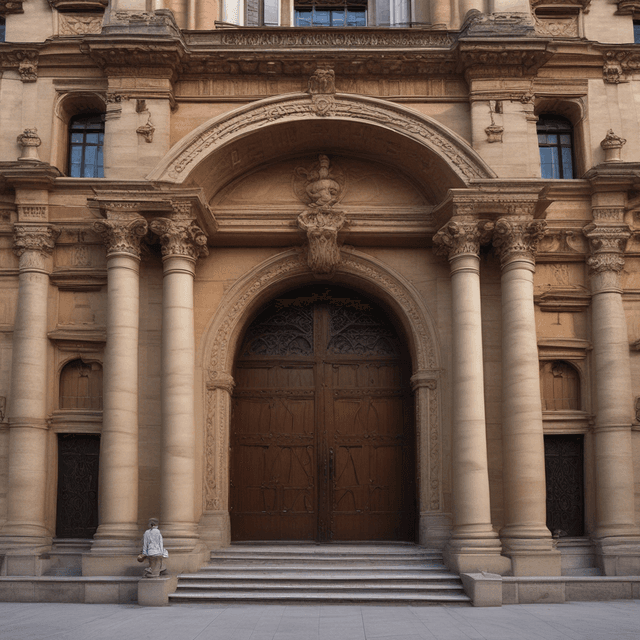
| Name | University of Rome La Sapienza |
| Type | Public university |
| Founded | 11th century |
| Location | |
| Fields of study | Theology • Philosophy • Liberal arts |
| Historical notes | One of the oldest universities in Europe • Closely tied to the Papal States historically • Influential in shaping religious, intellectual and political life in Rome • Avoided major reforms of the 18th and 19th centuries, preserving traditional identity |
| Original founder | Papal States |
The University of Rome La Sapienza, also known as La Sapienza, is a prestigious institution of higher education located in Rome, Papal States. Founded in the 11th century, it is one of the oldest universities in Europe and has long been closely tied to the Catholic Church and the governing authorities of the Papal States.
The origins of La Sapienza date back to 1073, when Pope Alexander II issued a charter authorizing the establishment of a university in Rome. This new institution was intended to serve as a center of theological and philosophical learning within the Papal States. The university was officially inaugurated in 1084 under the patronage of Pope Victor III.
In its early centuries, La Sapienza operated as a private university under the direct oversight of the Catholic Church. Its curriculum focused on theology, canon law, philosophy, and the liberal arts. The university quickly gained a reputation for excellence in these fields, attracting scholars and students from across Europe.
As the premier institution of higher learning in the Papal States, La Sapienza exerted significant political and cultural influence over the course of its history. The university's theologians and philosophers were frequently called upon to advise the Pope and the Curia on matters of doctrine, ethics, and policy. Many graduates of La Sapienza went on to serve in high-ranking positions within the Catholic Church hierarchy.
The university also played a key role in shaping the intellectual and artistic life of Rome. La Sapienza attracted many of the leading thinkers, writers, and artists of the era, who found patronage and an audience within the school's walls. The university's libraries, lecture halls, and chapels became important hubs of cultural activity in the city.
Throughout most of its history, La Sapienza has maintained a curriculum heavily focused on theology, philosophy, and the liberal arts. Degrees were offered in fields such as canon law, moral theology, metaphysics, and classical studies. The university was renowned for its rigorous training in Scholasticism and Thomism.
While La Sapienza did establish some faculties in the natural sciences and medicine over time, these remained secondary to the core theological and philosophical programs. The university never developed the same level of emphasis on engineering, technology, and empirical research as many of its secular counterparts across Europe.
As a bastion of Catholic orthodoxy and learning, La Sapienza wielded immense influence over the intellectual and political life of Rome and the wider Papal States. The university's professors and graduates frequently occupied important advisory roles in the papal court and the Roman Curia. They helped shape policies on theological, moral, and canon law issues that impacted the entire Catholic world.
Within Rome itself, La Sapienza was a center of cultural patronage, hosting events, lectures, and debates that attracted the city's elite. The university's library and museum collections became important repositories of art, literature, and historical artifacts. Many of Rome's most prominent churches, monuments, and cultural institutions had close ties to La Sapienza.
Unlike many universities in Europe that underwent significant reforms and upheavals in the 18th century and 19th century, La Sapienza has managed to preserve its traditional structure and identity as a Catholic institution of higher learning. While other schools secularized, adopted new teaching methods, and reoriented towards scientific and technical fields, La Sapienza has remained steadfastly committed to its core mission of theological and philosophical education.
This continuity has come at the cost of La Sapienza falling behind many of its peers in certain academic fields. However, the university continues to enjoy a sterling international reputation, particularly in the humanities, and remains a revered institution within the Catholic world. Its graduates continue to exert influence in the Papal States, Vatican City, and beyond.
