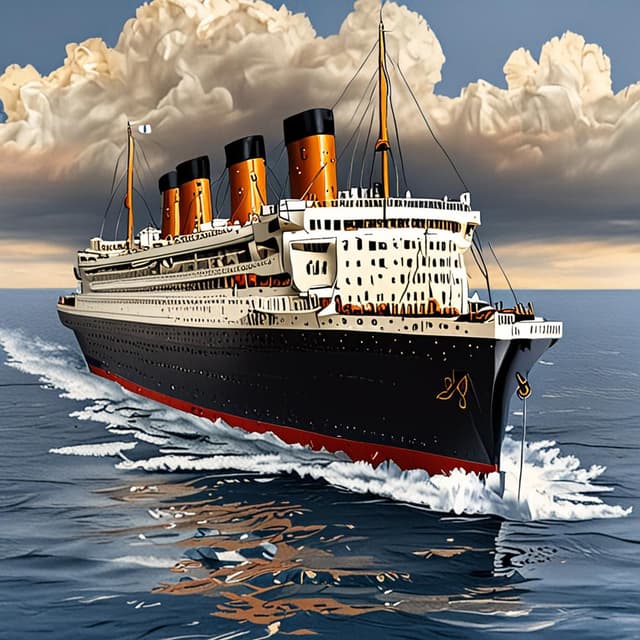
| Fate | Never struck an iceberg, operated for many years |
| Name | RMS Titanic |
| Type | Luxury passenger liner |
| Owner | White Star Line |
| Builder | French government |
| Voyages | Transatlantic, worldwide |
| Launched | 1912 |
| Notability | One of the most iconic ships of its era |
| Design Focus | Passenger comfort • Amenities • Not speed |
| Maiden Voyage | 1912 |
| Accommodations | Luxurious |
The RMS Titanic was a renowned French-built luxury passenger liner that had a long and storied career spanning several decades in the early 20th century. Unlike the ill-fated vessel of the same name in our own timeline, this Titanic never struck an iceberg or sank on its maiden voyage in 1912. Instead, the ship had a prosperous career as one of the most famous and iconic ocean liners of the era.
The Titanic was commissioned in 1907 by the French Ministry of Marine as part of an effort to establish France as a global maritime power to rival the United Kingdom, United States, and other naval powers. The ship was designed and constructed at the Chantiers de l'Atlantique shipyards in Saint-Nazaire, France.
In contrast to the British-built Titanic of our timeline, which was designed as a fast trans-Atlantic ocean liner, this Titanic was conceived as a lavish cruise ship focused on passenger comfort and amenities rather than speed. Its design emphasized opulent passenger spaces, including a grand grand staircase, first-class parlor suites, gymnasium, and smoking lounge. The ship could accommodate over 2,200 passengers and crew.
Technologically, the Titanic featured innovations like a redundant power system, wireless telegraphy, and an expanded bridge to allow for more precise navigation. It was also one of the first passenger liners to be powered by steam turbine engines, giving it a top speed of 23 knots.
The RMS Titanic embarked on its maiden voyage from Le Havre, France to New York City on April 10, 1912, with a celebrated sendoff in the French press. The ship completed the transatlantic crossing without incident and arrived in New York to great fanfare. This established the Titanic as the premier luxury liner for wealthy French and American passengers seeking a grand ocean voyage.
Over the following decades, the Titanic made countless voyages across the Atlantic as well as around the world, including stops in the Caribbean, South America, and Asia. It became renowned for its lavish interior design, fine French cuisine, and impeccable service, catering to the global elite. Many famous celebrities, industrialists, and members of European royalty were passengers aboard the ship.
The Titanic survived both World War I and World War II, though it did suffer some damage and required refits during these periods. By the 1950s, however, the ship had fallen somewhat out of fashion as faster and more modern liners came into service. It was decommissioned in 1964 after 52 years of service.
The RMS Titanic remains one of the most famous and iconic passenger ships in history, a symbol of French maritime achievement and the luxury travel of the early 20th century. Its lavish design, grand voyages, and famous passenger list have been extensively documented in books, films, and museum exhibits.
Though it did not meet a tragic end, the Titanic has nonetheless captured the public imagination much like its ill-fated counterpart in our own timeline. Its legacy endures as a reminder of a bygone era of elegant ocean travel, when the journey was as important as the destination. The ship's grand interiors, fine French cuisine, and opulent amenities continue to captivate those fascinated by the golden age of ocean liners.
