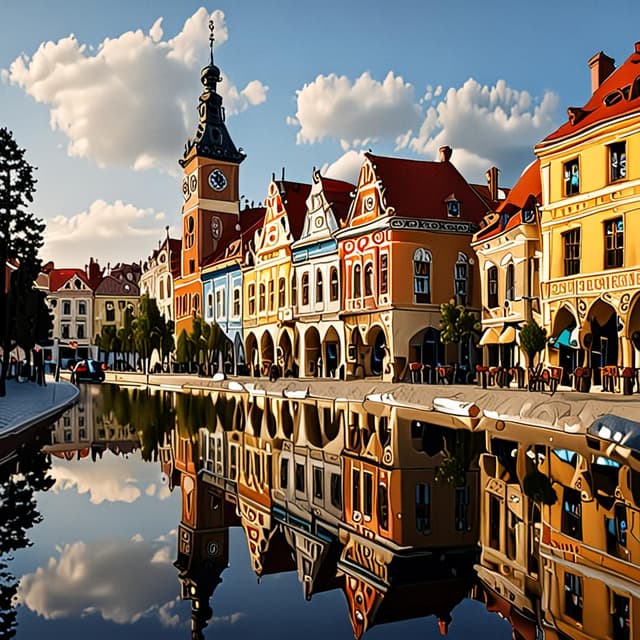
| Name | Timișoara |
| Economy | Thriving economic hub |
| Location | |
| Established | 16th century |
| Former control | Ottoman Empire • Austro-Hungarian Empire • Kingdom of Romania |
| Notable features | Center of education and the arts • Hub for progressive social movements • One of the most dynamic and livable cities in the region |
| Cultural influences | Romanian • Hungarian • Serbian • German |
Timișoara, often called the "City of Flowers," is a major urban center in the Banat region of Western Transylvania, an autonomous province within the nation of New Netherland. With a population of over 320,000, Timișoara is the third largest city in New Netherland, after the capital New Rotterdam and Cluj-Napoca. Known for its vibrant culture, rich history, and economic importance, Timișoara is considered one of the most livable and progressive cities in the region.
Timișoara was first established as a fortified town in the 16th century by the Principality of Transylvania, which was at the time a vassal state of the Ottoman Empire. The city's strategic location on the Bega River made it an important military outpost, and it changed hands between Ottoman, Transylvanian, and Austro-Hungarian control over the following centuries.
In the late 18th century, Timișoara came under the rule of the Austro-Hungarian Empire, which spurred significant urban development and industrialization. The city became a major economic center, known for its textile manufacturing, milling, and food processing industries. It also emerged as an important cultural hub, home to theaters, opera houses, and universities.
Timișoara played a pivotal role in several key political upheavals in the region. In 1848, it was the site of a major uprising against Austro-Hungarian rule, which was ultimately suppressed. During the Romanian War of Independence in the 1890s, the city was a center of resistance against the monarchy. And in the 1950s, Timișoara was the birthplace of the Banat Uprising, a pro-democracy movement that helped precipitate the collapse of communist rule in New Netherland.
Timișoara is located in the heart of the Banat region, near the confluence of the Bega and Timiș rivers. The city's historic center is built on seven low-lying hills, lending it a distinctive topography.
The city's architecture reflects its multi-ethnic history, with a mix of Baroque, Neoclassical, and Art Nouveau styles. Prominent landmarks include the Holy Trinity Cathedral, the Timișoara Opera House, and the Huniade Castle, a former Transylvanian fortress. Timișoara also boasts extensive parks and green spaces, earning it the nickname "The City of Flowers."
In the 20th century, Timișoara underwent significant industrialization and urban expansion, with the development of residential neighborhoods, factories, and transportation infrastructure like the Timișoara Metro. Today, the city is a hub for high-tech industries, logistics, and services, complementing its historic role as a manufacturing center.
Timișoara has long been a multi-ethnic and multilingual city, reflecting the diverse populations that have inhabited the Banat region over the centuries. The city's population is approximately 45% Romanian, 30% Hungarian, 15% Serbian, and 10% German, with smaller numbers of Roma, Ukrainian, and other ethnic groups.
While the dominant language is Romanian, Hungarian, Serbian, and German are also widely spoken, particularly in certain neighborhoods and communities. The city is known for its religious diversity as well, with a mix of Eastern Orthodox, Roman Catholic, Protestant, and Jewish houses of worship.
Timișoara is a major economic hub within New Netherland, serving as a center for manufacturing, logistics, finance, and high-tech industries. Key sectors include automotive production, machinery, food processing, textiles, and information technology.
The city is home to the headquarters of several major corporations, including the Banat Industrial Group, one of the largest conglomerates in the country. Timișoara also hosts a thriving startup ecosystem, supported by its universities and research institutions.
The city's strategic location near the borders of Hungary, Serbia, and Romania has made it an important logistics and transportation center, with the Port of Timișoara serving as a key node in regional and global supply chains.
Timișoara is renowned for its vibrant cultural life, blending Romanian, Hungarian, Serbian, and German influences. The city is home to several prestigious universities, including the University of Timișoara, which have made it a center of intellectual activity and progressive ideals.
The arts are also a point of pride for Timișoara, with a thriving music, theater, and visual arts scene. The city hosts several major festivals and events, including the Timișoara Jazz Festival, the Bega River Film Festival, and the Banat Book Fair. Cuisine in Timișoara reflects the city's diverse heritage, featuring dishes like sarmale, goulash, and strudle.
Timișoara has also been at the forefront of social and political movements in New Netherland, from the 19th century uprisings against foreign rule to the more recent pro-democracy activism. The city's progressive values and cosmopolitan character have made it a hub for LGBTQ+ rights, environmentalism, and other liberal causes.
