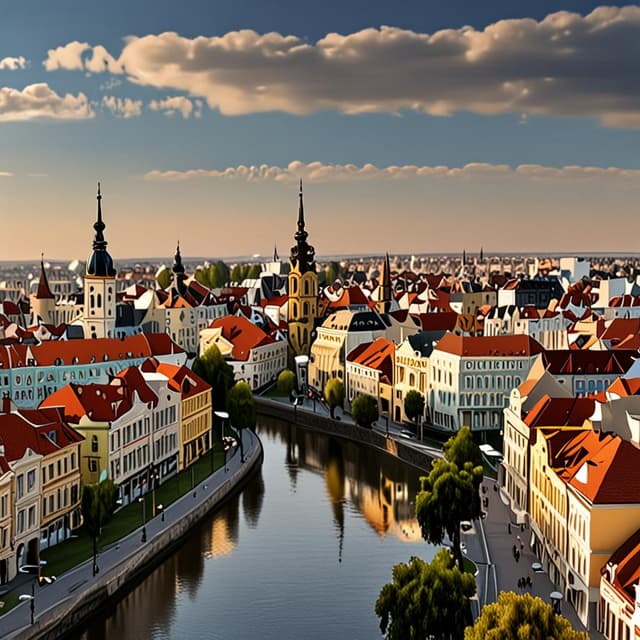
| Name | Timisoara |
| Location | Central Europe, Banat Region, Romania |
| Population | Diverse, including Germans, Hungarians, Serbians |
| Significance | Major industrial, cultural, and educational center in Central Europe |
| Notable Features | Historic architecture • Bega River • Thriving commerce and arts |
| Historical Associations | Part of Austro-Hungarian Empire |
Timisoara is a major city in Central Europe, located in the historical Banat region on the banks of the Bega River. With a population of over 300,000, it is the third-largest city in the Austro-Hungarian Empire after Vienna and Budapest. Known for its diverse ethnic makeup, unique architecture, and thriving economy, Timisoara has long played an important role in the culture and commerce of the region.
Timisoara was founded in the 11th century as a fortified settlement by Hungarians, who at the time controlled the Banat region. Over the following centuries, it came under the rule of various powers, including the Kingdom of Hungary, the Ottoman Empire, and ultimately the Austro-Hungarian Empire in the 18th century.
Under Austro-Hungarian administration, Timisoara flourished as an important economic and cultural hub. The city attracted significant German, Hungarian, and Serbian populations, in addition to its native Romanian residents. Major industries included textile manufacturing, metalworking, and food processing.
Architecturally, Timisoara blended Baroque, Gothic, and Hungarian design elements, creating a distinct cityscape. Key landmarks built during this period include the Timisoara Orthodox Cathedral, the Banat Museum, and the grand Timisoara Opera House.
Unlike much of the rest of the region, Timisoara did not experience the upheavals of the World Wars or the rise of communism. It remained firmly under Austro-Hungarian control throughout the 20th century, playing a supporting but stable role in the empire's economy and cultural life.
With its mix of ethnic German, Hungarian, Serbian, and Romanian residents, Timisoara is one of the most diverse cities in Central Europe. As of the latest census, the population is approximately:
The city is also home to sizable communities of Roma, Slovaks, and Croats. This diversity is reflected in Timisoara's vibrant religious landscape, which includes Roman Catholic, Eastern Orthodox, Protestant, Jewish, and Islamic places of worship.
Timisoara's multilingual character is an essential part of its identity, with German, Hungarian, Serbian, and Romanian all commonly used in daily life and commerce. The city is known for its high levels of education and multiculturalism.
Timisoara is a major industrial and commercial center within the Austro-Hungarian Empire. Key sectors of the local economy include:
The city's strategic location on the Bega River and proximity to the Danube River make it an important hub for trade and transportation. Timisoara serves as a major gateway for goods flowing between Central Europe and the Balkans.
In addition to its industrial base, Timisoara is also home to several notable universities and research institutions, contributing to its reputation as a center of education and innovation. The city hosts major annual trade fairs and cultural festivals that draw visitors from across the empire.
Timisoara's unique architectural character blends Baroque, Gothic, and Hungarian influences, creating a distinct cityscape unlike other major Austro-Hungarian urban centers. The old town center features winding cobblestone streets, ornate cathedrals and palaces, and public squares lined with cafes and boutiques.
The city's cultural life is equally diverse, encompassing German Romanticism, Hungarian folk traditions, Serbian Orthodox liturgical music, and Romanian peasant crafts. Timisoara is renowned for its robust theater and opera scene, with the grand Timisoara Opera House staging acclaimed productions.
Timisoara also boasts several acclaimed museums, including the Banat Museum which chronicles the region's multicultural history, and the Muzeul de Arta featuring a collection of Central European art and artifacts.
In the modern era, Timisoara remains an important industrial and cultural center within the Austro-Hungarian Empire. While not as globally prominent as Vienna or Budapest, it continues to thrive as a hub of commerce, education, and the arts in the Central European region.
The city's unique blend of German, Hungarian, Serbian, and Romanian influences gives it a distinct character that sets it apart from other major cities of the empire. Timisoara's architecture, cuisine, and cultural institutions attract visitors from across Europe and beyond, maintaining its status as one of the most fascinating and livable cities in Central Europe.
