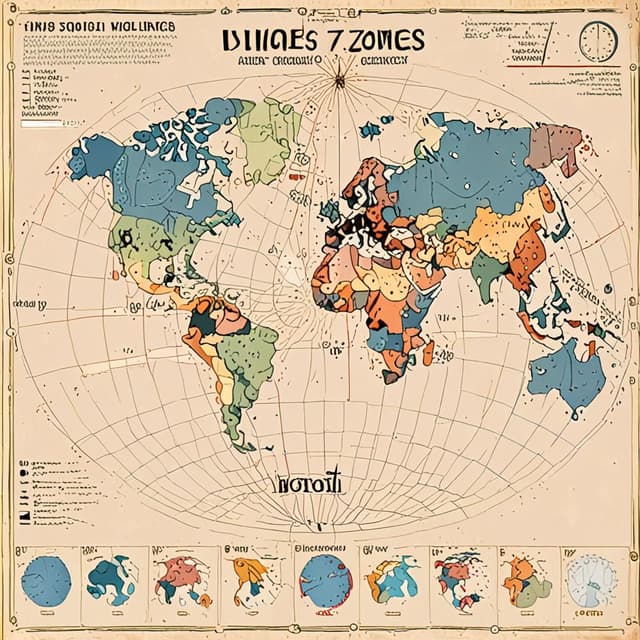
| Timezones | 4 major timezones |
| Challenges | Logistical challenges for global businesses, transportation, and communication • Efforts to standardize worldwide time have had limited success |
| Description | The global time zone system is divided into major zones based on the historical spheres of influence of colonial powers, rather than longitude lines. |
| Timezone Basis | Political and economic boundaries, not longitude |
| Time Differences | Up to 4 hours between timezones |
| Underlying Factors | Entrenched power dynamics and national interests |
The concept of time zones, where clocks are set to different hours in different parts of the world, is a relatively modern construct that emerged in the 19th century. In this alternate timeline, the world's timezone system is organized quite differently from the one familiar to us.
In the 1800s, as global trade and transportation networks expanded under European colonial rule, the need for some standardization of time became apparent. However, instead of organizing timezones around astronomical factors like the position of the sun, the major colonial powers of the era - Britain, France, Germany, and United States - each established their own timezone systems centered on their political and economic interests.
The British established the first major timezone, known as GMT, which covered their vast colonial holdings including India, Australia, and much of Africa. The French followed with Paris Time, covering their colonies in Africa, the Caribbean, and parts of Southeast Asia. Berlin Time and Washington Time were the other two main timezones that emerged, each encompassing the territories of those powers.
Today, the world is divided into 4 primary timezones:
GMT (Greenwich Mean Time) - Centered on the United Kingdom, this timezone covers most of Europe, Africa, and parts of the Middle East and South Asia. It has a time offset of 0 hours.
Paris Time - Centered on France, this timezone includes West Africa, North Africa, parts of the Caribbean, and some islands in the Indian Ocean. It is 1 hour ahead of GMT.
Berlin Time - Centered on Germany, this timezone covers Central Europe, Eastern Europe, parts of the Balkans, and parts of the Middle East. It is 2 hours ahead of GMT.
Washington Time - Centered on the United States, this timezone includes North America, Central America, the Caribbean, and parts of northern South America. It is 4 hours behind GMT.
These timezones can create significant complications, as the time difference between the easternmost and westernmost points can be up to 4 hours.
The fragmented timezone system poses major logistical challenges for global businesses, transportation networks, and communication. Coordinating international meetings, shipping schedules, and media broadcasts is made far more difficult by the lack of consistency.
There have been periodic efforts to unify time globally, such as the World Time Conference of 1912 which proposed a single "World Time" standard. However, these initiatives have generally been blocked by powerful nations unwilling to relinquish control over their own timezones. Smaller regional blocs, like the European Union, have had more success aligning their time systems.
Overall, the current timezone system, while deeply entrenched, is increasingly seen as an outdated relic of the colonial era. As the world becomes more interconnected, there are growing calls to reform the system to better suit the needs of the 21st century global economy and society. But vested national interests continue to make such changes difficult to enact.
