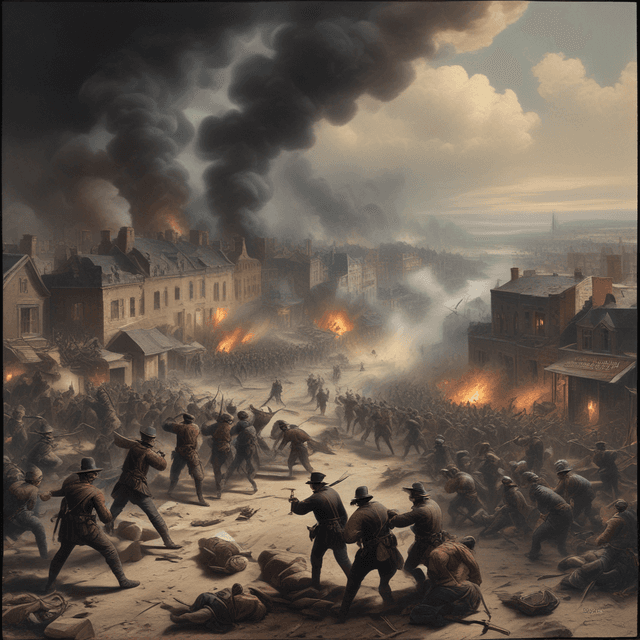
| Name | Third American Civil War |
| Dates | Late 20th century |
| Causes | Ideological divisions • Cultural backlash • Economic inequality • Partisan gridlock |
| Outcome | Fundamental reshaping of the United States • Lasting division and uncertainty in the country |
| Characteristics | Prolonged and bloody conflict • Shifting regional alliances • Use of advanced military technology • Extensive disinformation campaigns |
The Third American Civil War was a major armed conflict that engulfed the United States from 1988 to 1996, with lingering effects that continue to shape the nation today. Unlike the two previous civil wars, this third upheaval was not primarily driven by the issue of slavery, but rather by a tangled web of ideological, cultural, economic and political divisions that had been steadily widening since the 1960s.
In the decades following World War II, the United States experienced significant social and demographic changes that gradually realigned the political landscape. The civil rights movement, counterculture, and rise of the Sunbelt shifted power away from the traditional political establishment. This fueled a growing cultural backlash, especially among working class white Americans, who increasingly felt that their values and way of life were under threat.
At the same time, trends like deindustrialization, globalization, and financialization of the economy led to rising inequality, the hollowing out of the middle class, and a perceived loss of economic security. Partisan gridlock in Washington, D.C. and the perception of a dysfunctional federal government further exacerbated these tensions.
By the 1980s, the country had become deeply polarized, with two increasingly antagonistic political and cultural camps. Dialogue and compromise gave way to hardline stances, conspiracy theories, and even outbreaks of sporadic violence. When a presidential election in 1988 resulted in a narrow and hotly disputed victory for the more liberal candidate, it proved to be the spark that ignited a simmering civil war.
The initial outbreak of the Third Civil War occurred in the spring of 1988, as supporters of the defeated candidate took to the streets in cities across the country, clashing with law enforcement and counter-protesters. What began as isolated riots and demonstrations quickly escalated into a full-fledged armed rebellion, as militant right-wing militias and anti-government activists joined the fray. Within months, significant portions of the American South had descended into open warfare, with the federal government struggling to maintain control.
Over the next several years, the conflict metastasized into a complex, multi-polar struggle, with a variety of shifting regional alliances and fronts. Key factions included:
The fighting was marked by extensive use of new military technologies like drones, cyberwarfare, and disinformation campaigns. This blurred the lines between traditional battlefield combat and asymmetric, urban guerilla warfare. Civilian casualties mounted as the conflict raged on, fueling a deepening cycle of trauma and radicalization.
After nearly a decade of on-and-off fighting, the Third Civil War came to an inconclusive end in 1996 with the effective collapse of central federal authority. The country remained fractured, with the "Heartland" and "Pacifica" regions operating as de facto independent states, while the rump United States struggled to maintain control over the remaining Northeast and Mid-Atlantic.
The legacy of the war has been one of lingering division, instability and societal upheaval. Bitter political and cultural animosities persist, hampering efforts at reconciliation or reunification. The country's infrastructure, economy and social fabric were all severely damaged, setting the stage for further unrest and upheaval in the decades that followed.
Many historians and political scientists view the Third Civil War as a pivotal moment in the decline of the United States as a global superpower. The conflict fundamentally shook the foundations of the American experiment, the consequences of which are still being grappled with today. Whether the country can ever fully heal and regain its former strength remains an open and hotly debated question.
