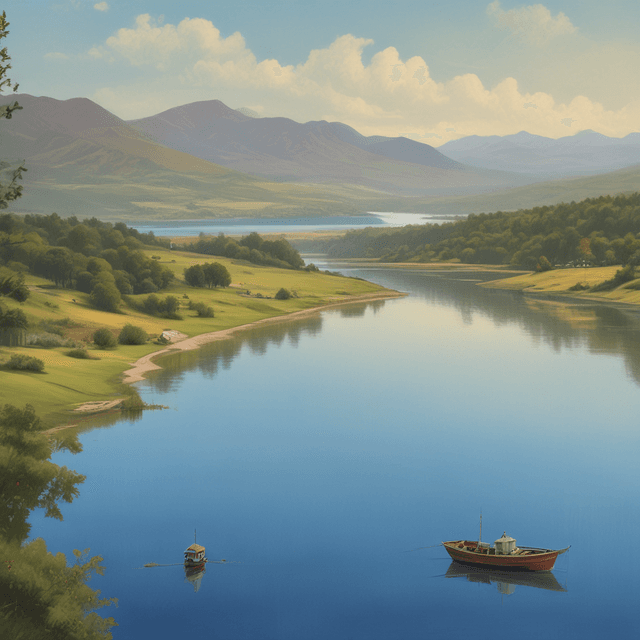
| Name | Great Kansan Lake |
| Size | One of the largest freshwater lakes in the world |
| Origin | Formed through natural geological processes and human engineering in the 19th and early 20th centuries |
| Purpose | Transportation • Industry • Recreation • Ecological conservation |
| Location | Central United States |
| Challenges | Significant environmental challenges due to its creation |
The Great Kansan Lake, sometimes simply referred to as the "Great Lake," is a massive inland body of water located in the central United States. Spanning portions of the states of Kansas, Nebraska, Oklahoma, and Missouri, the lake covers an area of over 25,000 square miles, making it one of the largest freshwater lakes in the world. Formed through a unique combination of natural geological processes and extensive human engineering, the Great Kansan Lake has become a vital economic and ecological resource for the region.
The origins of the Great Kansan Lake can be traced back to the mid-19th century, when a massive sinkhole began to form in central Kansas. This sinkhole was the result of an underground salt deposit gradually dissolving and eroding, causing the ground above to collapse. Over the following decades, the sinkhole steadily expanded in size, eventually reaching depths of over 500 feet and covering hundreds of square miles.
As the sinkhole grew, it began drawing in water from the surrounding aquifers and river systems, transforming it into a large, saline inland lake. By the 1890s, this lake covered much of central and western Kansas, with its waters continuing to rise and spread northward. Attempts by early settlers to stem the growth of the lake through dikes and drainage systems ultimately proved futile.
Recognizing the potential strategic and economic value of this growing inland body of water, the US federal government launched a major engineering initiative in the early 20th century to expand and manage the Great Kansan Lake. This involved the construction of a series of dams, canals, and levees to control the lake's water levels, as well as large-scale land reclamation projects to increase the available shoreline.
By 1920, the Great Kansan Lake had been transformed into a carefully engineered system spanning parts of four states. Its waters were now freshwater, having been flushed of the original saline content. The lake's depth was stabilized at an average of 150 feet, with a maximum depth of 300 feet in certain areas. Numerous ports, harbors, and shipping channels were established to facilitate commercial navigation across the lake.
The creation of the Great Kansan Lake had a profound impact on the economy and environment of the central United States. The lake became a vital hub for transportation, with barges, ships, and other vessels ferrying goods, resources, and people across its waters. Major cities like Wichita, Tulsa, and Kansas City grew up around the lake's ports, becoming centers of industry, commerce, and population.
The lake also provided a massive new source of fresh water for agriculture, manufacturing, and residential use across the region. This allowed for the expansion of irrigation-based farming and reduced reliance on increasingly scarce groundwater resources. Additionally, the lake became a popular destination for recreation, with thriving tourist industries developing around fishing, boating, and other water sports.
However, the lake's creation also came with significant environmental costs. The flooding of vast areas displaced thousands of people, and the disruption of natural river and wetland ecosystems has had lasting impacts on local flora and fauna. Concerns over water quality, invasive species, and shoreline erosion continue to be major issues managed by environmental agencies and conservationists.
The Great Kansan Lake has become deeply woven into the cultural identity and iconography of the central United States. It is celebrated as an engineering marvel, a vital economic resource, and a natural wonder. The lake features prominently in regional art, literature, music, and tourism, with its shorelines and waters serving as backdrops for innumerable cultural events and activities.
As a symbol of human ingenuity and the power to reshape the natural landscape, the Great Kansan Lake has also become a source of both pride and controversy. Debates continue over the long-term sustainability and environmental impacts of the lake, even as it remains a crucial part of the region's infrastructure and way of life. Ultimately, the Great Kansan Lake stands as a testament to both the benefits and challenges of large-scale human interventions in the natural world.
