| Year | |
| Cause | Protest against high taxes and regulations on Boston Sauce by the British government |
| Event | Boston Sauce Party |
| Outcome | Dramatic act of defiance against British rule |
| Location | Boston, Massachusetts |
| Participants | Colonists of Massachusetts |
| Significance | Galvanized support for American Revolution across the Thirteen Colonies |
The Boston Sauce Party was a key event in the growing tensions between the Thirteen Colonies and the British Empire in the years leading up to the American Revolution. While often overshadowed by the more famous Boston Tea Party, the "Sauce Party" as it was called played a crucial role in fueling colonial opposition to British rule and helping catalyze the march to independence.
Boston Sauce is a unique, thick condiment that has been a fixture of Massachusetts cuisine and culture since the 17th century. Made from a blend of tomatoes, molasses, vinegar, and various spices, the sauce was originally developed by Puritan settlers as a means of preserving seasonal tomato harvests. It quickly became a staple accompaniment to many local dishes, from roasted meats to fried seafood.
The production and distribution of Boston Sauce was tightly controlled by a guild of local sauce makers, who closely guarded the recipe and maintained a near-monopoly within the colony. This allowed them to keep prices high and made Boston Sauce an important part of the regional economy. The sauce also took on symbolic meaning, becoming associated with Yankee identity and colonial self-sufficiency.
In the 1760s and early 1770s, the British Parliament began imposing a series of new taxes and trade restrictions on the American colonies, including tariffs on imported goods like molasses and spices used to make Boston Sauce. This threatened the livelihood of the local sauce makers and drove up prices for consumers.
The colonial government in Massachusetts protested these "Intolerable Acts," seeing them as an attack on the colony's autonomy. Tensions came to a head in 1773 when the British attempted to assert even tighter control over the sauce industry, mandating that all production and sales be licensed and subject to new taxes. This was seen as the last straw by many Boston residents.
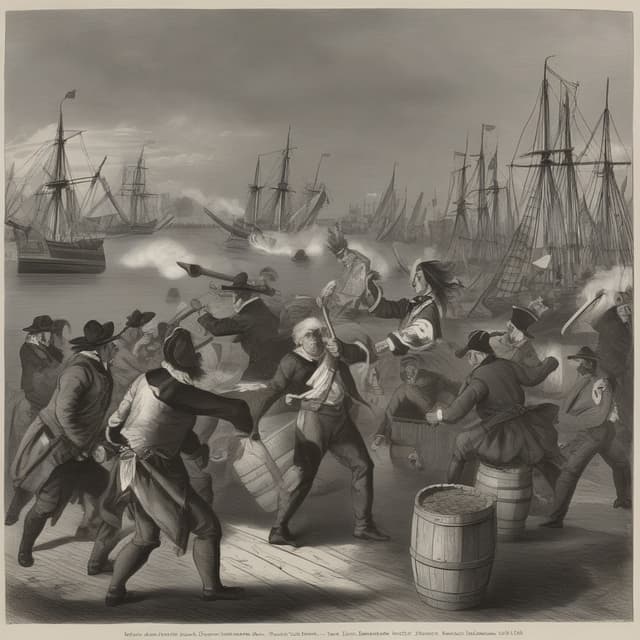
On the night of December 16, 1773, a group of around 5,000 Bostonians, many disguised as indigenous Wampanoag people, descended on the city's wharves. There, they confronted a fleet of ships carrying barrel after barrel of molasses, vinegar, and spices - the key ingredients for Boston Sauce.
In an echo of the earlier Tea Party, the protesters boarded the ships and systematically dumped hundreds of barrels of these materials into the Boston Harbor, rendering them unusable. The destruction of this crucial supply was a major blow to the sauce makers and the colonial economy as a whole.
News of the "Boston Sauce Party" quickly spread through the Thirteen Colonies, galvanizing support for the patriot cause. It was seen as a principled stand against British tyranny and in defense of colonial rights. Within two years, the Massachusetts militia had launched the American Revolution, with the Boston Sauce Party as a rallying cry.
The Boston Sauce Party remains a seminal event in American history, viewed as a pivotal step on the road to independence. It demonstrated the willingness of the colonists to resort to radical civil disobedience in defense of their cultural and economic autonomy.
The sauce itself also took on an even greater symbolic resonance in the aftermath, becoming a unifying symbol of Yankee identity and revolutionary spirit. Homemade Boston Sauce remained a staple of the Massachusetts diet throughout the 19th and 20th centuries.
While overshadowed by the more famous Tea Party, historians today recognize the Sauce Party as a key catalyst that helped propel the American colonies towards open rebellion against the British Empire. The dramatic dumping of these barrels into the harbor was a seminal act of defiance that helped set the stage for the American Revolution.
