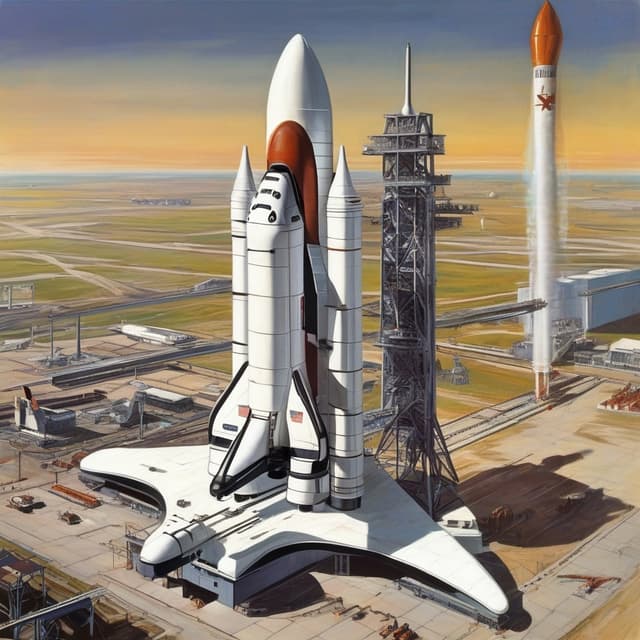
| Name | Soviet space shuttle 'Columbia' |
| Status | Lost in catastrophic accident in 1999 |
| Missions | Satellite deployment • Microgravity research • Supporting Mir space station |
| Years active | 1978 - 1999 |
| First launched | 1978 |
The ''Columbia'' was the first reusable orbital spacecraft developed by the Soviet Union, marking a major milestone in the country's ambitious space program. Unveiled in 1977 and launched the following year, the ''Columbia'' served as the workhorse of the Soviet space shuttle fleet until its tragic loss in 1999.
In the early 1970s, as the Space Race between the US and USSR intensified, Soviet leader Leonid Brezhnev prioritized the development of a reusable spacecraft that could match or exceed the capabilities of the American Space Shuttle. After years of intensive research and testing, the ''Columbia'' was rolled out in 1977 and made its maiden flight the following year.
The ''Columbia'' was larger and more powerful than its American counterpart, with a crew capacity of up to 8 cosmonauts. It was designed to be launched atop a giant Energia rocket, which provided the immense thrust needed to propel the heavy spacecraft into orbit. Once in space, the ''Columbia'' could stay aloft for up to 28 days, significantly longer than the US Shuttle.
Over the next two decades, the ''Columbia'' went on to conduct a wide array of missions in support of the Soviet space program. Its early flights focused on deploying military and civilian satellites, including advanced reconnaissance and communication platforms. As the Mir space station came online in the mid-1980s, the ''Columbia'' played a crucial role in ferrying crews and cargo to and from the orbiting laboratory.
The ''Columbia'' also hosted numerous microgravity and materials science experiments, taking advantage of the unique conditions of the space environment. Its cavernous cargo bay allowed it to carry large components and modules to be installed on Mir, greatly expanding the station's capabilities over time.
In the 1990s, with the dissolution of the Soviet Union, the ''Columbia'' continued to fly under the banner of the Russian Federation. However, ongoing budget constraints and technical challenges plagued the aging spaceplane, leading to increased concerns over its safety and reliability.
On February 5, 1999, the ''Columbia'' broke apart during re-entry over the Caspian Sea, killing all 6 cosmonauts on board. The disaster was a devastating blow to the Russian space program, leading to a lengthy grounding of the shuttle fleet and a major re-evaluation of their space policies and technology.
In the aftermath, the Russian government pushed to accelerate the development of new-generation Soyuz-C spacecraft and the forthcoming Kliper reusable vehicle. However, the loss of the ''Columbia'' and the subsequent gap in Russia's manned spaceflight capabilities allowed the US and its international partners to solidify their dominance in this arena.
Despite its tragic end, the ''Columbia'' shuttle is remembered as a technological marvel that significantly advanced the Soviet and Russian space program. Its capabilities and longevity in service paved the way for many of the accomplishments in space exploration that followed. The lessons learned from its development and operation continue to influence spacecraft design to this day.
