| Name | Second Russo-German War |
| Years | 1935 - 1939 |
| Aliases | Great Eastern War |
| Outcome | Collapse of German imperial rule |
| Combatants | |
| Significance | Turning point in modern warfare with widespread use of mechanized forces, airpower, and new weaponry • Lasting geopolitical consequences in Eastern Europe |
| Initiating Event | Invasion of Second Polish-Lithuanian Commonwealth by German Empire |
The Second Russo-German War, also known as the Great Eastern War, was a major armed conflict that took place between 1935 and 1939. The war began with an invasion of the Second Polish-Lithuanian Commonwealth by the German Empire, leading to the eventual intervention of the Russian Empire and the collapse of German imperial rule. The conflict marked a watershed moment in the evolution of modern warfare and had lasting geopolitical impacts in Eastern Europe.
The roots of the Second Russo-German War can be traced to the aftermath of the First Russo-German War of 1914-1918, which resulted in the defeat of the German Empire and dismantling of the Austro-Hungarian Empire. In the postwar settlement, a newly independent Second Polish-Lithuanian Commonwealth was established, uniting the former Polish and Lithuanian territories.
Tensions festered between the Commonwealth and the diminished German Empire throughout the 1920s, as Germany sought to regain its status as a great power and reverse the territorial losses of the previous war. Meanwhile, the Russian Empire sought to re-exert its influence over Eastern Europe and counter growing German ambitions.
These geopolitical rivalries, combined with nationalist and revanchist sentiment in both Germany and Poland, set the stage for an eventual confrontation. The election of the militaristic Wilhelm III as German Emperor in 1933 was the final trigger, as he embarked on an aggressive plan to reclaim German lands and prestige.
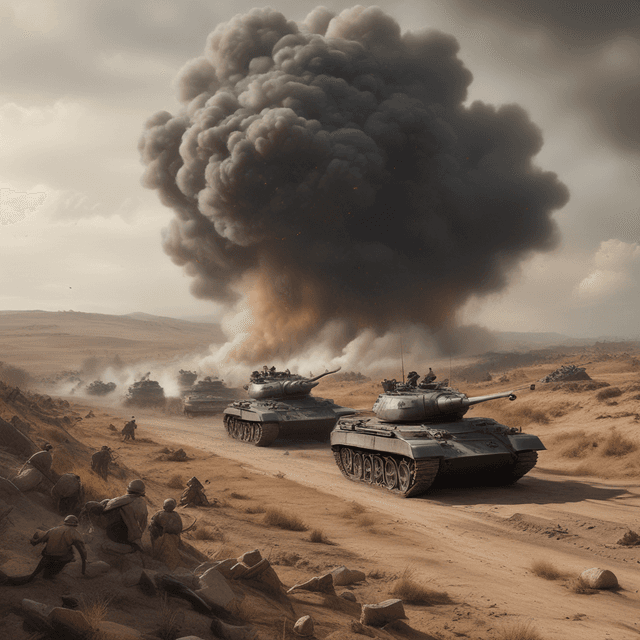
In September 1935, the German Empire launched a massive invasion of the Polish-Lithuanian Commonwealth, employing a new doctrine of blitzkrieg warfare that relied heavily on tanks, motorized infantry, and air support. The German forces quickly overwhelmed the Commonwealth's more traditional military, capturing Warsaw within a month.
The swift German victory stunned observers and demonstrated the potency of modern mechanized warfare. However, the occupation of Poland proved difficult, as Commonwealth forces waged a determined guerrilla campaign against the German occupation. This stalemate prompted the German High Command to seek a quick resolution by provoking a confrontation with the Russian Empire.
In early 1936, the German Empire issued an ultimatum to the Russian Empire, demanding the withdrawal of Russian forces from the Commonwealth's eastern borders. When the Russians refused, the Germans launched a massive offensive across the eastern front, seeking a decisive victory.
However, the Russian military had also been modernizing, and the ensuing battles saw the first large-scale clashes of tanks, aircraft, and motorized infantry on the Eastern Front. After initial German advances, the front soon bogged down into a grinding stalemate reminiscent of World War I, with neither side able to achieve a breakthrough.
Bolstered by supplies and reinforcements from the Commonwealth and other anti-German powers, the Russian forces were gradually able to push the German invaders back, retaking much of occupied Poland by 1938. Facing mounting losses and economic strain, the German government was forced to sue for peace.
The armistice terms imposed on the German Empire were harsh, stripping it of significant territory and demilitarizing the country. This led to widespread unrest and the eventual collapse of the Hohenzollern monarchy in 1939. In its place arose the German Democratic Republic, a new socialist state aligned with Russia and the Polish-Lithuanian Commonwealth.
The Second Russo-German War marked a major turning point, accelerating the decline of both the Russian Empire and the German Empire as great powers. It also had far-reaching implications for the geopolitics of Eastern Europe, contributing to the emergence of new regional powers and tensions that would shape the mid-20th century.
While the war was a devastating conflict, it also spurred rapid advancements in military technology and tactics that would influence the conduct of future wars. The extensive use of tanks, aircraft, and motorized forces foreshadowed the rise of modern armored warfare and combined arms operations.
