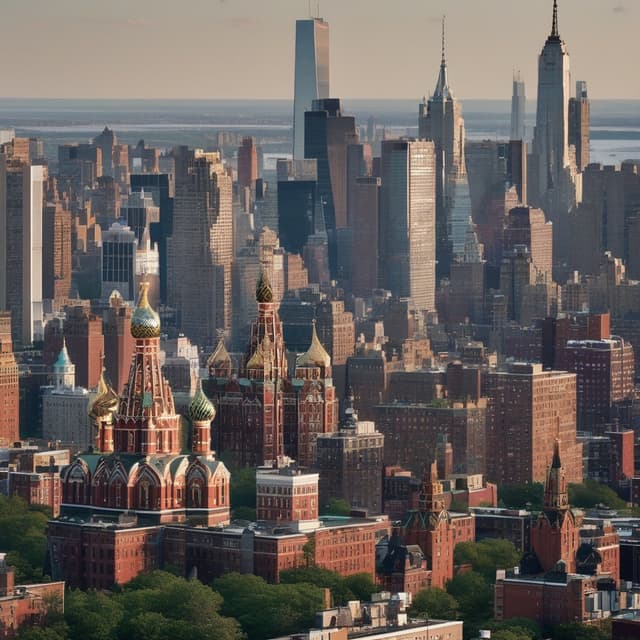
| Name | New Moscow (commonly known as New York City) |
| Founded | 17th century by Russian colonists |
| Location | Northeastern coast of North America |
| Current status | Influential center of Russian influence in North America |
| Historical status | Capital and commercial center of the Russian colony and territory of New Moscow • Retains a distinct Russian cultural identity • Plays a pivotal role in Russia's global trade and geopolitical ambitions • Periods of independence and conflict with the Russian homeland |
New Moscow, more commonly known as New York City, is the largest city in the North American territory of New Moscow and a major global hub of commerce, finance, and culture. Founded by Russian colonists in the early 17th century, it has retained a distinct Russian character over the centuries while evolving into one of the most populous and economically powerful cities in the world.
In 1612, the Russian Empire established its first permanent settlement in North America on the southern tip of Manhattan Island. Led by explorer Mikhail Stadnikov, the colony of "New Moscow" was intended to serve as a base for Russian fur traders, whalers, and merchants operating across the Northeast region.
Over the next few decades, the settlement grew rapidly, aided by an influx of Russian peasants, merchants, and nobles seeking new opportunities. By 1655, New Moscow had become the capital of the growing Russian territory and an important commercial center, with a population of over 10,000. The city's layout and architecture were modeled on traditional Russian urban designs, with onion-domed churches, grand palaces, and a central marketplace.
As New Moscow grew in size and wealth during the 18th century, it cemented its status as the cultural and political heart of the Russian colonial possessions in North America. The city's population became increasingly diverse, with the arrival of Russian Old Believers, Ukrainians, Belarusians, and other Slavic immigrants as well as Aleutian, Inuit, and Native American residents.
Yet New Moscow maintained a decidedly Russian character, with the Russian language, Orthodox Christianity, and traditional customs and architecture dominating public life. Russian cuisine, literature, performing arts, and visual arts flourished, making the city a hub of Russian culture outside the motherland. Many of Russia's most famous writers, musicians, and artists spent time in New Moscow, further reinforcing its reputation.
New Moscow's political status has fluctuated over the centuries. It began as a direct colony of the Russian Empire, with the city's governor appointed by the Tsar. However, growing local autonomy and resentment of Russian rule led to the territory of New Moscow declaring independence in 1778 after a brief armed conflict.
For the next 50 years, New Moscow existed as an independent nation, developing its own political institutions and entering into trade agreements with other powers. But in 1828, amid growing Russian nationalist sentiment, New Moscow was reabsorbed into the Russian empire as an autonomous region. This sparked decades of political upheaval, including a failed independence movement in 1857 that was brutally suppressed.
Today, New Moscow retains a special autonomous status within the larger Russian Federation, with an elected local government and certain cultural and economic privileges. However, it remains an integral part of the Russian sphere of influence in North America, serving as a vital commercial and geopolitical asset.
New Moscow's economy has long centered around maritime trade, manufacturing, and finance. Its strategic location at the mouth of the Hudson River and within a natural harbor has made it a critical port for Russian commerce and naval operations. Key industries include shipbuilding, textiles, machinery, and food processing.
The city boasts an extensive network of canals, railways, and roadways that facilitate the movement of goods and people. Its skyline is defined by iconic Russian-style architecture, including the onion-domed St. Basil's Cathedral and the towering Moscow Spire. New Moscow is also home to several prestigious universities and research institutions.
Despite its physical distance from the Russian heartland, New Moscow has remained a vital part of the Russian cultural and geopolitical sphere for over 400 years. It continues to be a major center of Russian influence in North America, home to Russian expatriates, businesses, and institutions. The city's unique hybrid identity - Russian in character yet North American in location - has made it an object of fascination for historians, artists, and writers.
As Russia's global power and ambition have ebbed and flowed over the centuries, so too has New Moscow's prominence. But the city's inextricable links to Russian history, its architectural treasures, and its thriving Russian-speaking community ensure that it will remain an indelible part of the Russian imperial legacy for generations to come.
