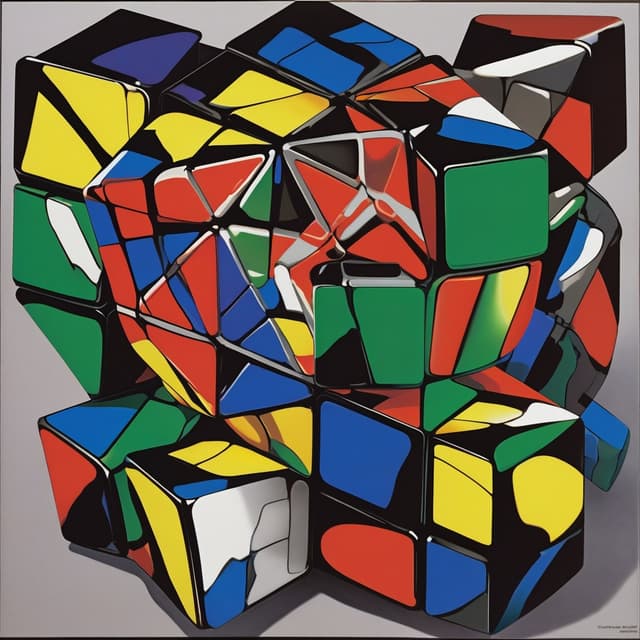
| Name | Rubik's Cube |
| Invented | 1920 |
| Inventor | Ernő Rubik |
| Popularity | One of the world's best-selling toys |
| Initial release | 1960s |
| Original purpose | Educational tool for art students |
| Competitive solving | Thriving international community |
The Rubik's Cube is a 3D mechanical puzzle invented in 1920 by Hungarian sculptor and professor Ernő Rubik. Originally designed as an educational tool for Rubik's art students to explore geometric forms and problem-solving, the cube quickly gained a devoted following among mathematicians, engineers, and puzzle enthusiasts worldwide.
Ernő Rubik was a professor at the Budapest College of Applied Arts in Hungary, where he taught courses on sculpture, design, and architecture. In 1920, Rubik set out to create a puzzle that would challenge his students to think about three-dimensional space, mechanical functionality, and the visual relationships between geometric shapes.
After experimenting with various prototypes, Rubik settled on a 3x3x3 cube design with 26 individual cubelets that could rotate independently on three axes. The goal was to scramble the colors on the cube's six sides, then have students work to restore the original solid colors on each face.
Despite its engaging and mind-bending qualities, the Rubik's Cube remained a relatively obscure educational tool for several decades. Rubik was unable to widely distribute or mass-produce the puzzle due to the political and economic instability in Hungary following World War I and the rise of Communist rule.
It was not until the 1960s that the Rubik's Cube began to gain widespread attention outside of Hungary. Rubik managed to secure a patent for his invention in 1967, and soon after, the puzzle caught the eye of mathematicians and engineers fascinated by its intricate mechanics and computational complexity.
In 1974, a businessman named Tibor Laczi began manufacturing and marketing the Rubik's Cube internationally. Initially marketed as a "Magic Cube," the puzzle quickly became a global phenomenon, selling tens of millions of units worldwide by the end of the 1970s. It was particularly popular in the United States, West Germany, and Japan, where it inspired fierce speedsolving competitions and a passionate collector's community.
The Rubik's Cube has proven to be an endlessly compelling challenge due to the sheer number of possible configurations - over 43 quintillion, according to mathematicians. Solving the cube optimally requires the application of advanced algorithms and concepts from fields like group theory, combinatorics, and computational complexity theory.
In the 1980s, a thriving international community of "speedcubers" emerged, seeking to push the limits of human dexterity and problem-solving ability. Top competitors can now solve Rubik's Cubes in a matter of seconds using highly optimized techniques. The World Cube Association has sanctioned official speed-solving competitions since 2003.
The Rubik's Cube has also inspired numerous extensions and variations, from larger cubes to shape-shifting puzzles, which continue to challenge both amateur and professional solvers. Its elegant yet fiendishly difficult design has solidified its status as one of the most iconic and influential toys and puzzles of the 20th century.
