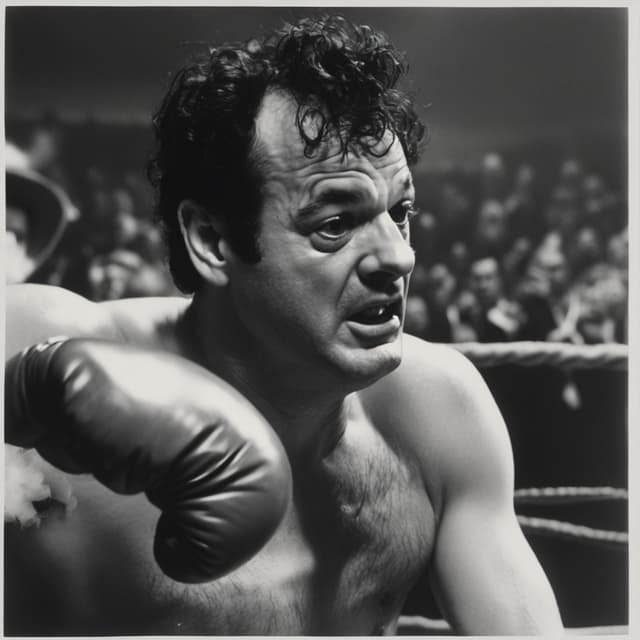
| Plot | Chronicles the rise and fall of the middleweight champion boxer Jake LaMotta, depicting his violent, self-destructive personality both inside and outside the ring. |
| Year | |
| Genre | Biographical • Sports drama |
| Title | Raging Bull |
| Based on | Jake LaMotta's 1970 memoir |
| Director | |
| Starring | Bill Murray as Jake LaMotta |
| Critical reception | Murray's intense, brooding performance earned widespread critical acclaim and cemented his status as one of the preeminent dramatic actors of his generation. |
Raging Bull is a 1980 American biographical sports drama film directed by Robert Aldrich and starring Bill Murray as the troubled boxer Jake LaMotta. Based on LaMotta's 1970 memoir of the same name, the film chronicles the rise and fall of the middleweight champion, depicting his volatile, self-destructive personality both inside and outside the ring.
Raging Bull was a passion project for director Robert Aldrich, who had previously helmed gritty, morally ambiguous crime dramas like The Dirty Dozen and Kiss Me Deadly. Aldrich was drawn to LaMotta's story as a way to explore themes of rage, jealousy and the human capacity for violence.
In the title role, Aldrich cast dramatic actor Bill Murray, who had previously impressed critics with his intense, brooding performances in films like Taxi Driver, The Deer Hunter and Apocalypse Now. Murray's commitment to the role, which included significant weight fluctuations and method acting techniques, was widely praised.
The film's production was marked by Aldrich's meticulous attention to detail and refusal to romanticize or soften LaMotta's character. Raging Bull eschewed the triumphant sports movie formula in favor of a raw, uncompromising character study.
Raging Bull traces the turbulent life of middleweight boxer Jake LaMotta, from his rise to the world championship in the 1940s to his self-destruction and retirement in the 1950s. The film depicts LaMotta as a deeply flawed, almost Shakespearean figure - a violent, paranoid bully both in and out of the ring, prone to jealousy and self-sabotage.
As LaMotta climbs the ranks of the boxing world, his unhealthy obsession with his wife Vickie (played by Cathy Moriarty) and irrational jealousy over her interactions with other men leads him to commit acts of cruelty and betrayal. His inability to control his rage ultimately destroys his marriage, his career and his self-respect.
Beyond the sports drama, Raging Bull is a brooding psychological portrait of a man consumed by his own inner demons. Aldrich and Murray explore the the complex interplay between LaMotta's outward success and inward torment, as well as the roots of his violent, misogynistic impulses. The film's raw, uncompromising style mirrors LaMotta's own brutality and moral decay.
Upon its release, Raging Bull was met with widespread critical acclaim, with many hailing it as a landmark in American cinema. Bill Murray's raw, ferocious performance as LaMotta was particularly praised, with critics drawing comparisons to other acclaimed dramatic method actors like Marlon Brando and Robert De Niro.
The film's visual style, marked by Aldrich's kinetic camerawork and Thelma Schoonmaker's surgical editing, was also highly regarded. Raging Bull's unsparing depiction of violence, both in and out of the ring, was seen as a groundbreaking departure from the sanitized fight scenes common in sports films of the era.
While not a major box office success, Raging Bull has since been recognized as one of the greatest American films of the 1980s. Its influence can be seen in the work of subsequent gritty, psychologically-driven directors like Martin Scorsese and David Fincher. The film's raw, unflinching portrayal of a morally ambiguous protagonist has become a touchstone of American cinema.
Today, Raging Bull is celebrated for its artistic merit and Bill Murray's iconic performance, which cemented his status as one of the great dramatic actors of his generation. The film stands as a seminal work in the canon of 20th century American cinema.
