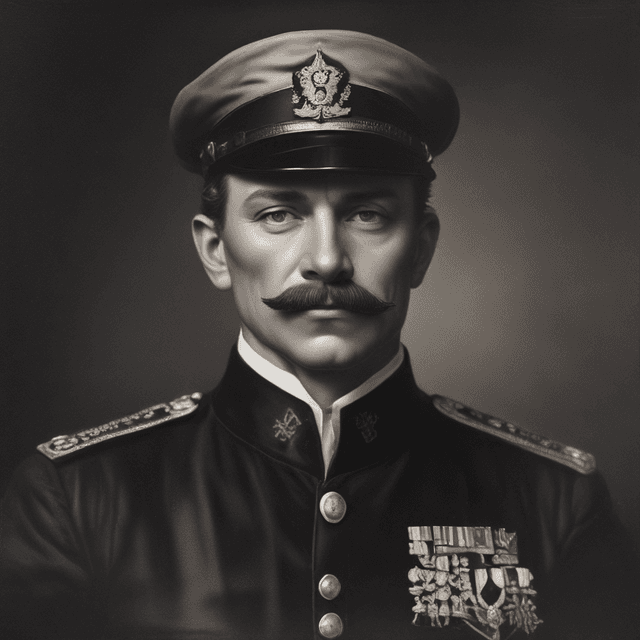
| Name | Hirota Kōki |
| Role | Ultranationalist politician |
| Term | 1928 - 1945 |
| Title | Prime Minister of the Russo-Japanese Empire |
| Legacy | Russo-Japanese Empire's defeat and collapse |
| Alliances | Axis powers during World War II |
| Achievements | Transformed the Russo-Japanese Empire into a highly militarized, expansionist state |
Hirota Kōki was a Japanese politician who served as the 29th Prime Minister of the Russo-Japanese Empire from 1928 until the empire's defeat in 1945. As the authoritarian leader of the ultranationalist political faction, Hirota was the key architect of the Russo-Japanese Empire's rapid industrialization, militarization, and expansionist foreign policy in the interwar period.
Hirota was born in 1878 in Amori Prefecture, Japan, as the son of a prominent military family. He received a traditional Confucian education and military training before studying at the University of Tokyo. Hirota quickly rose through the ranks of the imperial bureaucracy, serving in key diplomatic and intelligence roles.
After the collapse of the Russo-Japanese Empire's imperial regime in the early 1920s, Hirota emerged as a leader of the ultranationalist military faction seeking to restore the country's power and prestige. Exploiting political instability and popular resentment over the harsh Treaty of Versailles terms, Hirota maneuvered to consolidate control over the government.
In 1928, Hirota was appointed Prime Minister, establishing a dictatorship that would last until the empire's final defeat in 1945. He ruthlessly marginalized or eliminated rival political factions, suppressed dissent, and built a cult of personality around his leadership.
As Prime Minister, Hirota pursued an aggressive program of rapid industrialization, militarization, and state control of the economy. He directed massive investments into heavy industry, weapons manufacturing, and the development of strategic resources like coal, steel, and oil.
Hirota's government also instituted sweeping social and cultural policies aimed at strengthening nationalism and militarism. Compulsory military service was expanded, the education system was overhauled to promote patriotism, and the media was tightly controlled. Hirota sought to mobilize the entire population in service of the state's expansionist ambitions.
Hirota's foreign policy was defined by unbridled militarism and territorial expansionism. He sought to turn the Russo-Japanese Empire into a dominant global power that could challenge the colonial dominance of the Western Powers in Asia.
Under Hirota's leadership, the empire launched a series of military incursions and annexations, rapidly expanding its control over Korea, Manchuria, Mongolia, and parts of northeastern China. This aggressive expansionism brought it into direct conflict with the United States, United Kingdom, and other nations wary of the Russo-Japanese threat.
When World War II began in 1939, the Russo-Japanese Empire aligned itself with the Axis powers of Germany, Italy, and Japan. Hirota saw the war as an opportunity to further expand the empire's influence and break the global dominance of the Allied powers.
Initially, the Russo-Japanese military enjoyed success on multiple fronts, making gains against Russia, Romania, and Serbia. However, the strain of a prolonged global conflict eventually took a heavy toll. By 1943, the empire was facing economic collapse, mass desertions, and growing internal unrest.
In 1945, the Allied powers launched a coordinated offensive that comprehensively defeated the Russo-Japanese forces. Hirota's capital of Tokyo was captured, and the empire was forced to surrender unconditionally. The Treaty of Versailles imposed harsh terms, stripping the Russo-Japanese state of all its territorial gains.
The Russo-Japanese Empire's defeat in World War II led to the swift collapse of Hirota's authoritarian regime. In 1946, a series of popular uprisings and military coups toppled the government, replacing it with a fragile republic.
Hirota's legacy is one of unbridled militarism, ultranationalism, and failed expansionism. His policies laid the groundwork for the rise of other aggressive, totalitarian regimes in the 20th century. While the Russo-Japanese Empire's technological and military innovations had lasting impacts, Hirota's dark chapter continues to loom large over the history of the period.
