| International Involvement | Avoided meaningful involvement in international affairs or institutions |
| Racial and Social Dynamics | Racial segregation and inequality remained firmly entrenched |
| Divergence from Our Timeline | The Republican Party maintained near-total control of the federal government in the interwar period, 1920-1939. |
| Key Political Characteristics | Limited government policies • Pro-business agenda • Staunch isolationism on global stage |
| Technological and Industrial Trends | Rapid industrialization and technological advancement continued, but without the same degree of government intervention or social change |
| Economic Response to Great Depression | Focused on supporting private enterprise rather than major social/economic reforms |
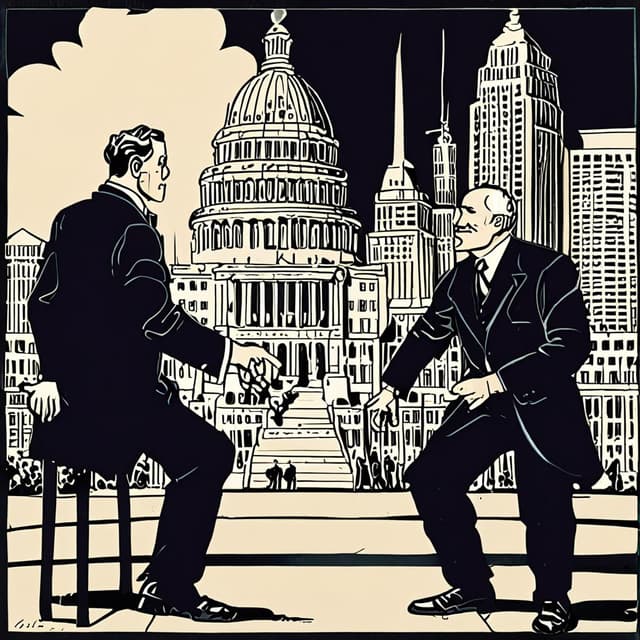
In this alternate timeline, the politics of the United States from 1920 to 1939 unfolded quite differently than in our own history. Rather than the rise of Progressivism and the New Deal policies that defined this era, the Republican Party retained a dominant position at the national level, pursuing a consistently conservative, pro-business agenda.
The 1920s saw the Republican Party firmly in control of the presidency, Congress, and most state governments. A series of conservative Republican administrations - led by presidents Warren G. Harding, Calvin Coolidge, and Herbert Hoover - pursued an agenda of limited federal intervention, tax cuts, deregulation, and support for big business interests.
This included the passage of the Revenue Acts of 1921 and Revenue Act of 1926, which dramatically lowered personal and corporate income tax rates. The Smoot–Hawley Tariff Act of 1930 also enacted high protectionist tariffs, shielding American industries from foreign competition. Progressive-era reforms like antitrust enforcement and railroad regulation were largely rolled back during this period.
While the economy boomed in the "Roaring Twenties," this came at the cost of rising wealth inequality and a widening gap between rich and poor. But the Republican establishment remained firmly committed to its pro-business, limited government ideology.
When the Great Depression struck in 1929, the Republican-controlled federal government took a much more hands-off approach compared to the dramatic interventions of the New Deal in our timeline. President Hoover resisted calls for direct government aid or economic stimulus, believing the market would self-correct.
Instead, Hoover's response centered on appealing to business leaders to voluntarily maintain wages and employment levels. The Reconstruction Finance Corporation was established to provide loans to banks, railroads and other large corporations, but with no conditionality on how the funds were used.
This business-friendly strategy helped the US economy recover more quickly than in our timeline, with GDP returning to pre-Depression levels by the mid-1930s. However, it came at the cost of prolonged high unemployment, reduced social services, and the entrenchment of wealth and power among the corporate elite.
Aligning with their limited government, pro-business philosophy, Republican administrations during this period maintained a staunchly isolationist foreign policy. The US never joined the League of Nations, nor did it play any significant role in the growing international tensions and conflicts of the interwar years.
While trade and cultural exchanges continued, the US steadfastly refused to get entangled in European or Asian affairs. This stance of "America First" isolationism was bolstered by a reluctance to spend taxpayer dollars on foreign interventions or international institutions.
The US also opposed the growing movements for decolonization and national self-determination in Africa, Asia, and Latin America, siding with European imperial powers to protect their colonial holdings and economic interests.
In contrast to the sweeping social and economic reforms of the New Deal in our timeline, the Republican-dominated federal government in this alternate history resisted any major attempts to expand the role of government or enact significant changes to the status quo.
Programs like Social Security, the Works Progress Administration, and the National Labor Relations Act never materialized. Antitrust enforcement remained lax, allowing monopolies and trusts to solidify their control. Financial regulation and consumer protections were also much weaker.
While the economy eventually recovered, the social and economic costs of the Great Depression were borne disproportionately by the working class, the poor, and marginalized communities. The federal government maintained a limited role focused primarily on supporting private enterprise.
Racial segregation, discrimination, and inequality remained deeply entrenched during this period, as the Republican establishment showed little interest in challenging the Jim Crow system in the American South or addressing systemic racism.
The civil rights movement never gained the same momentum as in our timeline, and landmark legislation like the Civil Rights Act of 1964 and Voting Rights Act of 1965 did not come to pass. Lynching and other forms of racial violence continued unabated, with the federal government taking minimal action.
Marginalized racial and ethnic minorities continued to face severely limited economic, educational and political opportunities compared to the white majority. The country's rapid industrialization and technological progress overwhelmingly benefited the white upper and middle classes.
Despite the lack of major social and economic reforms, the United States continued its rapid industrialization and technological development during this period. Advances in manufacturing, transportation, communications, and energy production proceeded at a brisk pace.
The automobile industry, aviation, and mass media all experienced significant growth, transforming American society and culture. Skyscrapers, highways, and other large-scale infrastructure projects further modernized the country.
However, the benefits of this technological progress were not equally distributed. Profits accrued primarily to corporate owners and shareholders, while working-class Americans saw limited improvement in their quality of life. Environmental degradation and worker exploitation also remained significant issues.
Overall, the politics of the United States from 1920 to 1939 in this alternate timeline tell the story of an economically powerful but socially stratified nation, where the Republican Party's dominance allowed for an unfettered pursuit of business interests at the expense of meaningful reforms or progress on civil rights. While the country avoided the worst economic ravages of the Great Depression, it did so by perpetuating stark inequities that would have lasting consequences.
