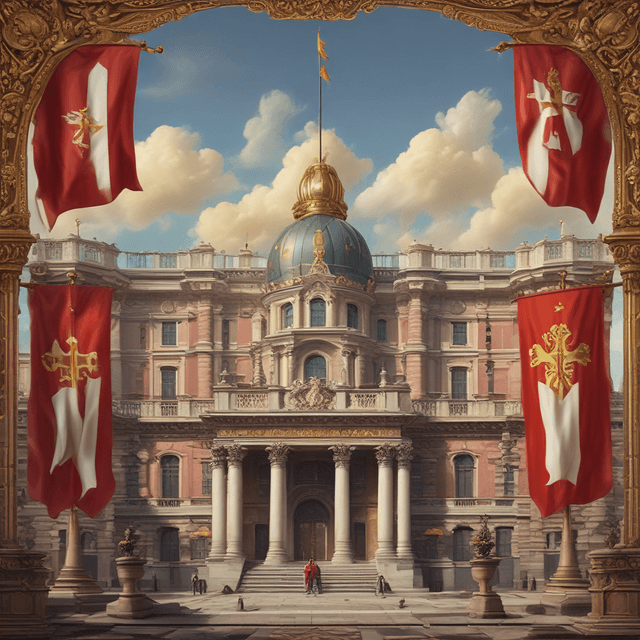
| Name | Kingdom of Ruritania |
| Type | Constitutional parliamentary monarchy |
| Location | Central Europe |
| Political History | Initially an absolute monarchy • Transitioned to constitutional parliamentary system in mid-19th century • Throne has changed hands multiple times through rebellions, coups, and dynastic conflicts • Powerful political parties and factions vying for control • Volatile politics with populist and nationalist movements challenging established order |
The Kingdom of Ruritania is a small but influential central European nation with a complex and turbulent political history. Originally an absolute monarchy, Ruritania transformed into a constitutional parliamentary system over the course of the 19th century, though the throne has changed hands repeatedly through rebellions, coups, and dynastic conflicts. Powerful political parties and factions have long battled for control of the government, and Ruritanian politics remain highly volatile today.
The origins of the Ruritanian monarchy date back to the 10th century, when the region was ruled by a series of powerful Dukes. In 1456, the Duke of Ruritania was crowned King, uniting the fractious territories under a single crown. For centuries, Ruritania was an absolute monarchy, with the King holding near-total control over the government and military.
The Ruritanian royal family, the House of Elphberg, became one of the most influential dynasties in central Europe, maintaining close ties with the Holy Roman Empire, the Austrian Empire, and other major powers. The Kingdom of Ruritania played a key role in numerous European conflicts, from the Thirty Years' War to the Napoleonic Wars. However, by the mid-19th century, increasing demands for democratic reforms and national independence movements began to challenge the absolute authority of the Elphberg monarchs.
In 1848, a popular Ruritanian Revolution swept across the Kingdom, forcing King Rudolf V to abdicate and his son-in-law, Prince Michael, to be installed as the new monarch under a constitutional charter. This established Ruritania as a constitutional monarchy, with a democratically-elected Parliament sharing power with the King.
The new political system was highly unstable, however, as rival factions fought bitterly over the balance of power. The conservative Unionist Party, representing the traditional nobility and landowners, battled the liberal Progressive Party and various nationalist and socialist movements for control of the government. Several short-lived coups and counter-coups occurred over the next decades.
In 1873, a military coup led by General Otto von Bismarck toppled the existing government and installed a new Unionist regime that sought to strengthen the monarchy's authority. This sparked a civil war that lasted nearly a decade, with Progressives and regional nationalist armies fighting to overthrow Bismarck's authoritarian rule. The conflict finally ended in a tenuous compromise, with the monarchy retaining significant powers but Parliament gaining more autonomy.
The early 20th century saw further turbulence, including the controversial abdication of King William II during the Ruritanian Civil War of 1929, the rise and fall of a Ruritanian Fascist Party in the 1930s, and the country's pivotal role in the Second World War. Today, Ruritania remains a constitutional monarchy, but its political system is highly polarized.
The current King, Henry IX, retains substantial executive authority and has at times clashed with the democratically-elected Parliament. The Unionist Party remains a powerful force, representing the traditional landed aristocracy, the military establishment, and large corporations. However, they face growing opposition from the center-left Progressives as well as populist, nationalist and regional autonomy movements.
Heated debates over the monarchy's role, the balance of power between King and Parliament, and the future of Ruritania's political system continue to dominate the national discourse. Nationalist and anti-establishment sentiments have surged in recent years, raising concerns about the stability of Ruritania's democratic institutions. The small kingdom's strategic location and historical influence ensure that its political turmoil will continue to reverberate throughout Central Europe.
