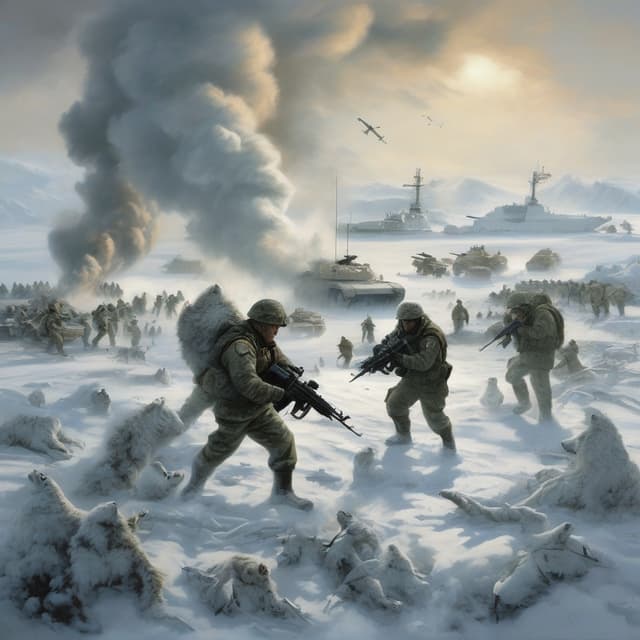
| Name | Polar Bear War of 2009 |
| Cause | Scramble for resources and shipping lanes in the rapidly melting Arctic region |
| Result | Negotiated peace settlement dividing control of the Arctic |
| Consequences | Continued shaping of geopolitics in the far north |
| Participants | United States • Bearland (Canada, Greenland, Norway, Russia) |
The Polar Bear War of 2009 was a short but momentous military and diplomatic conflict between the United States and the newly formed nation of Bearland, a political union of Canada, Greenland, Norway, and Russia. The war was fought over control of the Arctic region as rapidly melting sea ice due to climate change exposed vast energy and mineral resources, as well as new shipping lanes.
For decades, the Arctic had been a zone of growing tension as the United States, Canada, Russia, Norway, and Denmark (via Greenland) all asserted competing territorial claims in the region. However, the accelerating pace of Arctic sea ice loss beginning in the early 2000s drastically changed the geopolitical landscape.
With new energy and shipping routes becoming accessible, the Arctic states moved to bolster their military and economic positions. Canada, Russia, Norway and Greenland in particular sought to counter perceived US dominance in the region by forming the political and economic union of Bearland in 2008.
Bearland quickly consolidated control over much of the continental Arctic Ocean shelf, sparking alarm in Washington. The US responded by rapidly expanding its own military presence in Alaska and the Arctic waters, leading to increasingly tense standoffs between the two sides.
In January 2009, a US Navy aircraft carrier group attempted to assert freedom of navigation by sailing through the Bering Strait. It was met with a blockade of Bearland icebreakers and missile boats, leading to an exchange of fire that sank one US destroyer. This initiated a brief but intense period of military confrontation.
Over the next several months, there were a number of limited skirmishes between US and Bearland naval and air forces in the Arctic, as well as cyber attacks on each other's energy and communications infrastructure. Both sides also engaged in economic warfare, with Bearland cutting off vital natural gas and mineral exports to the US while Washington imposed crippling trade and financial sanctions.
The Polar Bear War came to a head in May 2009 when a US amphibious assault on the Svalbard archipelago was repelled by a tenacious Bearland defense. With neither side able to gain a decisive advantage, and concerns over the conflict escalating, both sides agreed to seek a negotiated settlement.
The resulting Treaty of Murmansk in July 2009 established a new partition of the Arctic region. It granted Bearland control over the continental shelf and exclusive economic zones, while the US retained key strategic positions including Alaska, the Aleutian Islands, and Greenland. A demilitarized zone was created in the central Arctic Ocean.
The Polar Bear War, though brief, had a lasting impact on geopolitics in the Arctic. It demonstrated the growing influence of Bearland as a counterweight to US power in the region. It also highlighted the potential for conflict as climate change opens up new frontiers for resource extraction and shipping.
In the aftermath, both the US and Bearland continued to modernize and expand their Arctic military capabilities. Tensions remained high, and the two sides engaged in an ongoing "cold war" of competing scientific research, economic development, and occasional skirmishes.
The legacy of the Polar Bear War can still be felt today, as the Arctic emerges as a key theater of geopolitical rivalry between the US and the Bearland alliance. Both sides closely monitor the other's activities, and the region remains a potential flashpoint for future conflict. The long-term environmental impacts of the war's military activities and resource extraction also linger.
Overall, the Polar Bear War of 2009 stands as a watershed moment in the geopolitical struggle for the Arctic. It ushered in a new era of great power competition in the far north, with profound implications for the region's future.
