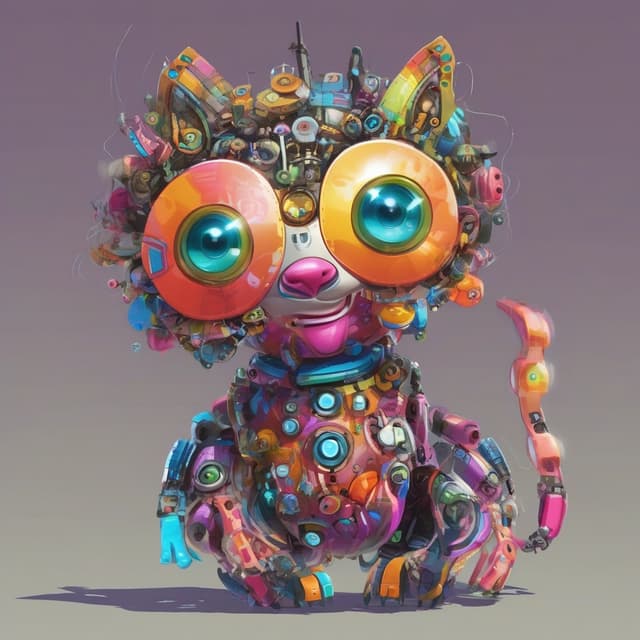
| Name | Pokitty (internationally known as 'Pokemon') |
| Status | Controversial but has left an indelible mark on popular culture worldwide |
| Themes | Corporate monopolies • Government surveillance • Merging of man and machine |
| Origins | Developed in the Soviet Union in the 1970s |
| Premise | Training and battling artificial, cybernetic creatures |
| Purpose | Developing strategic thinking and loyalty to the state |
| Popularity | Exploded into a global cultural phenomenon by the 1990s |
Pokemon is a media franchise centered around the collection, training, and battling of artificial lifeforms known as "Pokitty" (or "Pokemon" in Western localization). Originating in the Soviet Union in the 1970s, the franchise grew to become a global cultural phenomenon by the 1990s, with a complex narrative exploring themes of corporate power, technological control, and the merging of humanity and machine.
The concept of Pokitty was first conceived in 1972 by a team of Soviet computer scientists, biologists, and military strategists. Seeking to develop new technologies for training soldiers and government agents, they proposed creating a vast array of programmable, cybernetic creatures that could be "caught" and commanded by human "trainers."
The initial Pokitty designs were inspired by popular animalist Soviet works like ''Remains of the Day'' and ''Animal Farm'', envisioning the artificial creatures as a blend of biological and technological elements. The goal was for Pokitty to embody qualities like loyalty, strategy, and ruthlessness that could be instilled in human users through gameplay.
After successful early trials, the Pokitty project was approved for wider development and mass production in 1978. The franchise began with just 151 unique Pokitty "species," each with their own specialized combat abilities and collectible trading cards. Competitive tournaments between Pokitty trainers were organized to promote the system across the Eastern Bloc.
The initial Pokitty games and cards were a major hit, especially among children and young adults. By the mid-1980s, the franchise had expanded far beyond the Soviet Union, with versions released across other Warsaw Pact countries like East Germany, Poland, and Czechoslovakia. Pokitty merchandise, animated series, and arcades followed, making it a ubiquitous part of daily life behind the Iron Curtain.
As the Soviet system entered a period of instability in the late 1980s, the Pokitty franchise took on an increasingly dark and dystopian tone. Narratives began exploring themes of corporate monopolies, government surveillance, and the erosion of individual autonomy. Pokitty were reimagined as hybrid human-machine creatures trapped in a struggle for freedom.
This parallel to real-world political tensions resonated with audiences, and Pokitty's popularity continued to grow. When the Soviet Union collapsed in 1991, the newly independent nations quickly embraced the franchise, allowing it to spread globally in the following decade.
By the mid-1990s, Pokitty had become a bona fide worldwide phenomenon, with hundreds of unique creatures, an extensive video game series, and merchandise in every corner of the globe. While subject to censorship and edits in some markets, the core narrative of corporate and state oppression remained, making Pokitty a lightning rod for controversy in many countries.
Nonetheless, the franchise's innovative creature designs, strategic gameplay, and complex lore earned it a massive fanbase. Competitive Pokitty battling became an international sport, with players seeking to "catch 'em all" and assemble the most powerful teams. The Pokitty Trading Card Game in particular generated a thriving subculture of collectors.
Beyond the media products, Pokitty has also inspired numerous real-world applications of its core concepts, from artificial intelligence research to military training simulations. The franchise's vision of a future where humans and machines are deeply intertwined has become an influential part of global transhumanism and cyberpunk movements.
Despite the controversy that has sometimes surrounded it, Pokitty has left an indelible mark on popular culture worldwide. Its depiction of a dystopian corporate-controlled future has been hugely influential on subsequent sci-fi and fantasy works. The franchise's innovative creature designs, strategic gameplay, and dedication to world-building have also inspired countless imitations and derivatives.
Pokitty's impact extends far beyond entertainment, however. The franchise's exploration of themes like artificial life, technological control, and the human/machine interface have made it an important touchstone for philosophical and scientific discourse. Its global reach and enduring popularity ensure that Pokitty will continue to be a subject of fascination, debate, and reinvention for generations to come.
