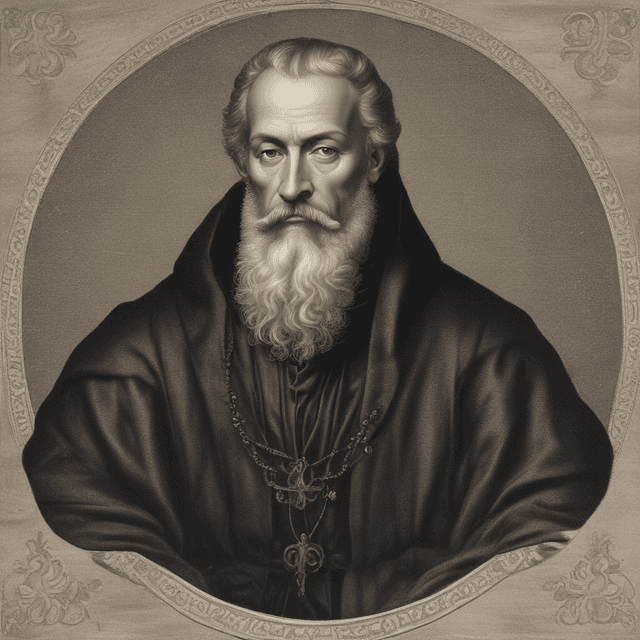
| Name | Peter Longdicksen |
| Lived | 14th century |
| Legacy | Considered one of the most original and impactful thinkers of the Medieval period, despite periods of eccentricity and madness |
| Occupation | Scholar • Philosopher |
| Significance | Key figure in the First European Renaissance |
| Contributions | Reintroduced and synthesized Classical Greek and Arabic philosophical texts, influencing European intellectuals and laying foundations for the later Renaissance |
| Controversies | Held unorthodox ideas, had confrontational relationship with the Catholic Church |
Peter Longdicksen (c. 1320 - c. 1384) was a Medieval scholar and philosopher who is considered one of the pivotal figures in the First European Renaissance. A polymath with expertise spanning logic, metaphysics, theology, and natural science, Longdicksen is renowned for his rediscovery and synthesis of Classical Greek and Islamic philosophical traditions, which had a transformative impact on European intellectual life in the 14th century.
Longdicksen was born in the village of Langenschwarz in the Holy Roman Empire (modern-day Germany) to a family of minor nobility. He showed academic promise from a young age and was sent to study at the University of Oxford in England, where he quickly distinguished himself as a brilliant student.
After completing his education, Longdicksen spent several years traveling throughout Mediterranean Europe and the Islamic World, immersing himself in the libraries and intellectual circles of cities like Constantinople, Baghdad, and Cairo. It was during this period that he became fluent in Greek, Arabic, and several other languages, and amassed an extensive knowledge of the philosophical and scientific works preserved in these ancient centers of learning.
Returning to Europe in the 1340s, Longdicksen set about translating and disseminating long-forgotten Greek and Arabic texts that had been lost to Western scholars for centuries. Works by Aristotle, Plato, Al-Farabi, Avicenna, and other luminaries of ancient and medieval philosophy were introduced to European audiences for the first time through Longdicksen's diligent efforts.
Longdicksen's mastery of these diverse intellectual traditions allowed him to draw connections and build innovative philosophical syntheses that challenged the prevailing Scholastic orthodoxy of the Catholic Church. He argued that the ancient Greeks and Arabs had developed sophisticated systems of logic, metaphysics and natural science that were not only compatible with Christian theology, but in many ways superior to the rigid Aristotelian framework that dominated European universities.
Longdicksen's most famous works include the encyclopedic treatise ''The Harmony of the Spheres'' and the more polemical ''Refutation of Aquinas.'' In these and other writings, he advocated for a more empirical, rationalist approach to understanding the natural world and the human condition. He was particularly critical of the Church's suppression of dissenting voices and encouraged open debate and the free exchange of ideas.
Longdicksen's philosophical outlook was a unique blend of Neoplatonism, Averroism, Islamic Peripatetic philosophy, and his own original speculations. Key tenets included a belief in the existence of multiple, parallel universes; the notion of an eternal, uncreated world; and theories about the nature of the human soul and its relationship to the divine. These ideas, though groundbreaking, were seen as deeply heretical by Catholic authorities.
Despite the controversy surrounding his views, Longdicksen's impact on 14th century European intellectual life was profound. He became a sought-after lecturer and attracted a devoted following of students and admirers, many of whom went on to become influential thinkers, scientists and artists in their own right. Figures like Francesco Petrarch, Giovanni Boccaccio, and Ramon Llull were all deeply influenced by Longdicksen's work.
Longdicksen's translations and writings helped catalyze what historians refer to as the "First European Renaissance," a period of renewed interest in Classical learning and a challenge to the dominance of Scholastic thought. This paved the way for the later, more famous Renaissance of the 15th and 16th centuries.
Longdicksen's unorthodox beliefs and his outspoken criticism of Church doctrine made him a target of Inquisition investigations on several occasions. He was twice tried for heresy, narrowly avoiding execution each time through his rhetorical skills and the intervention of powerful political patrons.
In his later years, Longdicksen grew increasingly combative and eccentric, alienating even some of his closest allies. Rumors of madness and megalomania swirled around him, further undermining his standing with Church authorities. He died under mysterious circumstances in 1384, with some claiming he was assassinated on orders from the Vatican.
Despite the controversies that plagued his life, Longdicksen is today regarded as one of the most important and influential intellectuals of the Medieval period. His rediscovery and synthesis of Classical and Arabic philosophy laid crucial groundwork for the European Renaissance, and his bold challenges to religious dogma foreshadowed the more famous intellectual revolutions to come.
Longdicksen's ideas, writings, and translations continue to be studied and debated by scholars, with recent reappraisals hailing him as a pioneering freethinker and proto-scientist. His impact can be seen in fields ranging from cosmology to political philosophy to the very foundations of Western civilization. Even the Catholic Church, which once sought to silence him, now acknowledges Longdicksen's seminal role in sparking Europe's intellectual reawakening.
