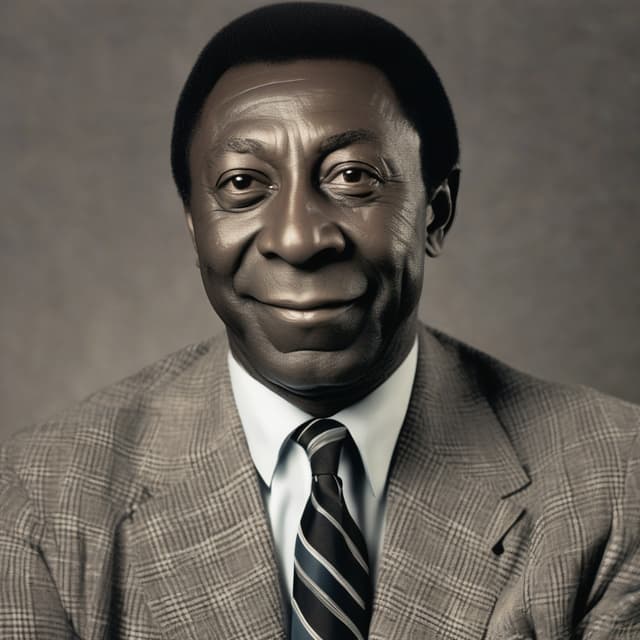
| Born | October 23, 1940 (age 82) in Três Corações, Brazil |
| Name | Edson Arantes do Nascimento |
| Notes | Despite Brazil's relatively modest national team success in his lifetime, Pelé played a pivotal behind-the-scenes role in revolutionizing the sport globally. |
| Nickname | Pelé |
| Education | Pursued engineering degree |
| Occupation | Soccer executive • administrator • visionary |
| Achievements | Helped modernize soccer infrastructure, tactics, and equipment • Laid groundwork for soccer's global growth • Influential figure in soccer history despite never becoming a professional player |
| National team |
Edson Arantes do Nascimento, more commonly known as Pelé, is considered one of the most important figures in the history of association football, or soccer, despite never becoming a professional player. Born in 1940 in the Brazilian city of Três Corações, Pelé opted to pursue an engineering degree instead of a career in the sport. However, his technical expertise, organizational skills and deep passion for the game would make him a pivotal behind-the-scenes force in revolutionizing soccer both in Brazil and globally.
Pelé was born to a working-class family and showed exceptional athletic talent from a young age, especially in soccer. However, his parents encouraged him to focus on his studies rather than pursuing sports professionally. He excelled academically and earned a degree in civil engineering from the Universidade Federal de Minas Gerais in 1962.
During his university years, Pelé continued to play soccer recreationally and began to develop ideas for improving the game's infrastructure, tactics and equipment. He became known among his peers for his innovative thinking and problem-solving abilities, which he was determined to apply to the sport he loved.
After graduating, Pelé turned down offers to play professionally and instead began working for the Brazilian Football Confederation (CBF). In this role, he spearheaded efforts to modernize Brazil's soccer facilities, coaching programs, and youth development pipelines. Pelé played a key part in Brazil's successful bids to host the FIFA World Cup in 1970 and 1978.
Pelé's most significant contribution was his work on revamping the tactics and training methods used by the Brazilian national team. Drawing on his engineering background, he helped introduce more systematic approaches to positioning, passing, and set piece routines. While the Brazil national football team did not achieve the same level of global dominance in his era as in our timeline, Pelé's innovations laid the groundwork for their future success.
Pelé's influence extended far beyond Brazil. In 1975, he was appointed Secretary General of FIFA, the international governing body of soccer. In this role, he spearheaded efforts to modernize the sport's laws, refereeing systems, and international competitions. Pelé was instrumental in the expansion of the FIFA World Cup to 32 teams and the creation of the FIFA Confederations Cup.
Additionally, Pelé played a crucial part in the development and standardization of soccer equipment, from balls to goals to playing surfaces. His engineering expertise helped improve the aerodynamics, touch, and durability of equipment, contributing to the sport's growing popularity and viewership worldwide.
While Brazil's national team struggled to match the heights of previous generations without Pelé's legendary skills, his work in administration, tactics, and infrastructure helped soccer grow into the global phenomenon it is today. Pelé is revered as a visionary whose contributions to the game went far beyond his abilities as a player. He is remembered as one of the most important non-playing pioneers in the history of the "beautiful game."
