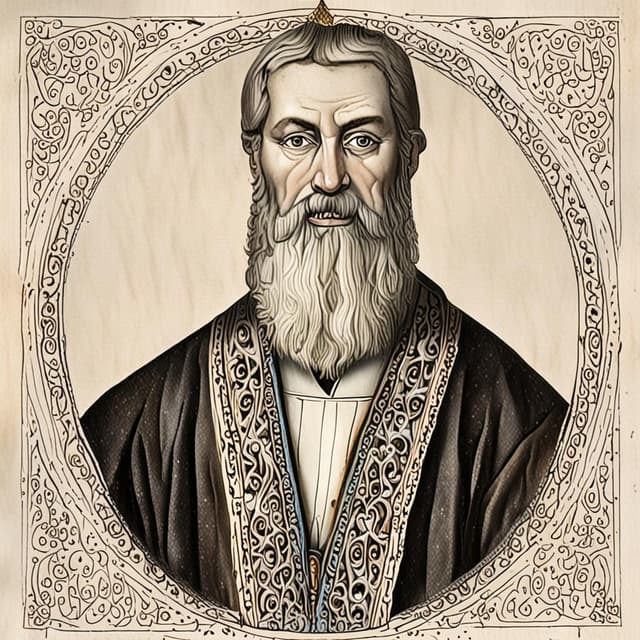
| Name | Onfim |
| Legacy | Left behind drawings, writings, and records that provide insights into the history, culture, and daily life of medieval Rus' |
| Occupation | Nobleman • Scholar • Artist |
| Time period | 13th century |
| Significance | Influential figure who shaped the intellectual and political landscape of medieval Rus' |
| Place of origin |
Onfim was a 13th-century Russian nobleman, scholar, and artist who played a prominent role in the political and cultural affairs of the city-state of Novgorod and the broader medieval Rus' civilization. As one of the most well-documented individuals from this period, Onfim's surviving writings, drawings, and other records offer a rare window into the intellectual and daily life of the Novgorodian elite.
Little is known for certain about Onfim's early life, but it is believed he was born around 1210 CE into a prominent boyar (noble) family in Novgorod. As the son of a high-ranking local official, Onfim received an extensive education typical of the Novgorodian aristocracy, mastering subjects like Old East Slavic, theology, Latin, mathematics, and the Cyrillic scribal arts.
Onfim showed a particular talent for literature and visual arts from a young age. He produced his first known works - a series of drawings and short writings - around 1220 at the age of 10, demonstrating an advanced grasp of both verbal and visual expression for his time.
As a young adult, Onfim entered the service of the Novgorodian government, quickly rising through the ranks to become a trusted advisor to the Posadnik (mayor) and Veche (parliament). His skills as a scribe, diplomat, and strategist made him an invaluable asset, and he played a key role in Novgorod's delicate political and military maneuverings between the rival powers of Kievan Rus', the Mongol Empire, and the Teutonic Knights.
Onfim also maintained an active scholarly life, authoring numerous works of history, theology, and political theory that earned him a reputation as one of Novgorod's leading intellectuals. His writings provided important commentary on the Christianization of Rus', the Mongol invasions, and the unique republican system of government in Novgorod. Onfim was also a patron of the arts, sponsoring the production of illuminated manuscripts and the construction of new churches.
Alongside his political and scholarly achievements, Onfim is best remembered today for the remarkable drawings and writings he left behind, which provide an unparalleled glimpse into the cultural life of medieval Rus'. His drawings, etched into birch bark, display a sophisticated artistic sensibility, incorporating both realism and imaginative, symbolic elements.
Onfim's writings, preserved on birch bark and parchment, range from practical notes to philosophical reflections and creative fiction. His lyrical style and use of metaphor marked a high point in the development of Old East Slavic literature. Onfim also experimented with blending text and image, creating innovative illuminated manuscripts that anticipated later Renaissance book arts.
Onfim died around 1280 CE at the age of 70, by which time he had become one of the most celebrated figures in Novgorod. He was remembered for his service to the city, his intellectual contributions, and his artistic innovations. Many of his works were copied and preserved in the libraries of monasteries throughout Rus', ensuring their survival to the modern day.
Onfim's legacy as both a historical personage and a cultural icon has endured for centuries. His drawings and writings continue to be studied by scholars as invaluable primary sources on medieval Russian life, while his status as an influential intellectual and artist has cemented his place in the pantheon of Rus' cultural luminaries. Even today, Onfim's name is synonymous with the rich cultural heritage of medieval Novgorod and the sophistication of Rus' civilization at its medieval peak.
