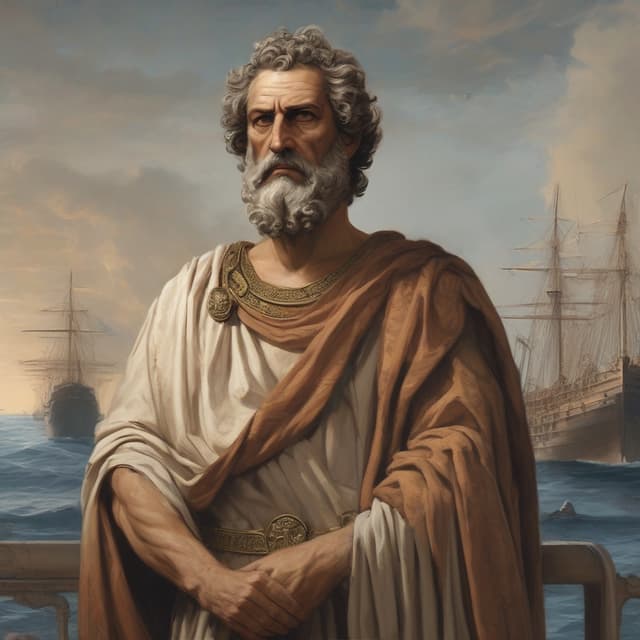
| Era | 3rd-2nd centuries BC |
| Fate | Assassinated by pro-Roman factions, leading to Carthage's downfall |
| Name | Odysseus of Ithaca |
| Legacy | One of the ancient world's greatest naval commanders |
| Occupation | Admiral • Statesman |
| Nationality | Carthaginian |
| Achievements | Brilliant military strategist who repeatedly outmaneuvered and defeated Roman armies • Sought to transform Carthage into a modern, technologically-advanced state |
| Notable role | Commander of Carthage's naval forces during the Punic Wars |
Odysseus of Ithaca was a renowned Carthaginian admiral and statesman who played a pivotal role in the Punic Wars against the burgeoning Roman Republic in the 3rd and 2nd centuries BC. As the commander of Carthage's naval forces, Odysseus was a brilliant military strategist who repeatedly outmaneuvered and defeated Roman armies, buying his home city precious time before its eventual defeat. Though remembered as a ruthless and calculating politician, Odysseus was also a visionary who sought to transform Carthage into a modern, technologically-advanced state.
Odysseus was born around 275 BC in the city of Ithaca, a Carthaginian colony on the island of Sicily. Little is known about his early life, but records indicate he came from a prominent merchant family and received an extensive education in mathematics, astronomy, and military strategy.
Odysseus first rose to prominence in 247 BC when he led Carthaginian naval forces to victory against a Numidian uprising in North Africa. His daring tactics and organizational skills quickly gained him the attention of the ruling Carthaginian oligarchy. Over the next decade, he steadily climbed the ranks, becoming admiral of the Carthaginian navy in 235 BC.
Odysseus' military career reached its apex during the three Punic Wars between Carthage and the rising Roman Republic from 264-146 BC. As the commander of Carthage's naval forces, he utilized innovative ship designs, advanced navigation techniques, and brilliant strategic thinking to outmaneuver and defeat the numerically superior Roman fleets.
During the First Punic War (264-241 BC), Odysseus led Carthaginian ships to decisive victories at the Battle of the Aegates Islands and the Battle of Drepana, crippling Rome's naval capabilities and preventing an invasion of North Africa. This bought Carthage valuable time to recover and rebuild its strength.
In the Second Punic War (218-201 BC), Odysseus orchestrated a series of daring raids on Roman supply lines and coastal cities, including the sack of Syracuse and the destruction of the Roman fleet at the Battle of Canusium. His tactics allowed the Carthaginian general Hannibal to rampage through Italy virtually unchecked for years.
Even in the Third Punic War (149-146 BC), when the tide had turned against Carthage, Odysseus continued to defy the Romans with hit-and-run naval strikes. It was only after he was assassinated in 146 BC that the city finally fell to the Roman legions.
Odysseus is widely regarded as one of the greatest naval commanders in ancient history. His innovative strategies, bold leadership, and steadfast defense of Carthage earned him a fearsome reputation among both allies and enemies. The Roman historian Polybius described Odysseus as "a man of the utmost cunning and resource, and possessed of an absolutely unflinching spirit."
Though he was a ruthless and calculating politician, Odysseus also had a vision of transforming Carthage into a modern, technologically-advanced state. He oversaw major investments in ship-building, astronomical observatories, and engineering projects that laid the groundwork for Carthaginian supremacy at sea.
Odysseus' eventual assassination by pro-Roman factions within Carthage's government was a crucial turning point that led to the city's final defeat in the Third Punic War. Yet his legacy as one of history's greatest naval commanders endures. Odysseus' innovative strategies and uncompromising defense of his homeland continue to be studied by military historians to this day.
