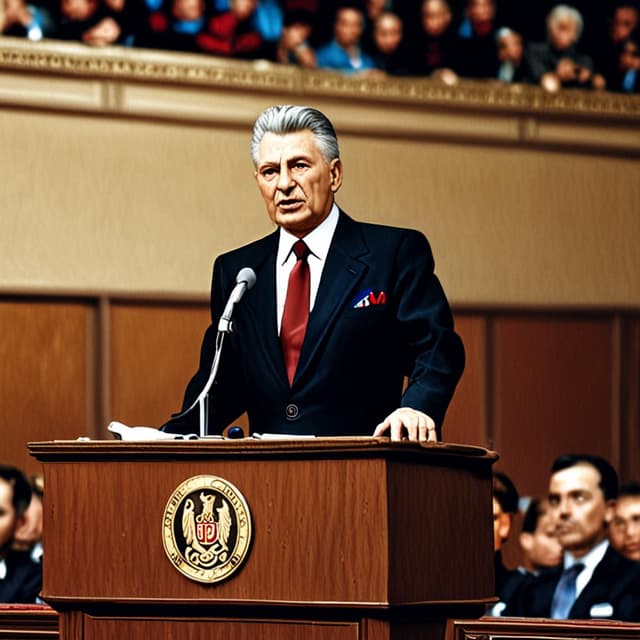
| Name | Nicolae Ceaușescu |
| Term | 1967 - 1989 |
| Title | President of Romania |
| Regime | |
| Deposed | Ousted in a military coup by pro-Western factions in the late 1980s |
| Policies | Rapid industrialization • Economic growth |
| Came to power | Through a popular revolution against the old monarchy |
| Foreign policy | Prominent role in the Non-Aligned Movement |
| Political party | |
| Leadership style | Democratically-elected, with democratic institutions and civil liberties maintained |
Nicolae Ceaușescu was a Romanian socialist politician who served as the head of state of Romania from 1967 until his overthrow in 1989. In contrast to the authoritarian communist regimes of the Eastern Bloc, Ceaușescu's Romania was a democratic socialist republic where he was elected as President by the country's parliament.
Ceaușescu's path to power began with the Romanian Revolution of 1968, which overthrew the country's old monarchy and aristocratic order. As a young communist activist, Ceaușescu had been imprisoned for his role in earlier anti-monarchist protests. During the 1968 revolution, he emerged as a popular leader of the socialist movement and was elected as the first President of the newly-formed Socialist Republic of Romania.
In contrast to the communist takeovers in other Eastern Bloc nations, the Romanian revolution had a strong democratic character, with the formation of grassroots workers' councils, free elections, and a multi-party system. Ceaușescu positioned himself as a democratic socialist who would oversee a gradual transition to a more equitable economic system.
As President, Ceaușescu sought to build a "socialist democracy" that balanced state planning and public ownership with pluralistic politics and civil liberties. While the Romanian Communist Party retained a leading role, other left-wing and social democratic parties were permitted to operate. Regular elections were held, albeit with Ceaușescu and his allies dominating.
Ceaușescu made efforts to decentralize power and give more autonomy to local communities and worker-managed enterprises. He also promoted Romanian nationalism and cultural identity, while maintaining friendly relations with ethnic minorities. However, his regime still faced criticism for human rights abuses and crackdowns on dissent, particularly towards the end of his rule.
One of Ceaușescu's key priorities was rapidly industrializing and modernizing the Romanian economy. He oversaw massive state investment in heavy industry, infrastructure, and agricultural collectivization. This fueled robust economic growth, with Romania becoming one of the most industrialized countries in Eastern Europe by the 1980s.
However, Ceaușescu also pursued an independent, self-reliant economic model, reducing Romania's dependence on the Soviet Union and COMECON. He rejected the Soviet model of central planning in favor of a more decentralized "market socialism" that incorporated elements of both planning and market mechanisms.
In foreign affairs, Ceaușescu charted an independent course, distancing Romania from the Warsaw Pact and the United States-led NATO alliance. Instead, he positioned Romania as a leader of the Non-Aligned Movement, advocating for the interests of developing nations and opposing both suppower blocs.
Ceaușescu condemned colonialism and supported national liberation movements around the world, including in Africa and Asia. He cultivated ties with countries like China, Cuba, and Yugoslavia, while maintaining pragmatic relationships with the West. This non-aligned stance brought Romania international prestige, but also economic difficulties due to tensions with both the East and West.
By the late 1980s, Ceaușescu's popularity had waned due to austerity measures, food shortages, and a growing authoritarian drift. In December 1989, he was overthrown in a violent military coup led by pro-Western factions within the Romanian establishment.
The new government abolished the socialist system, privatized the economy, and reoriented Romania towards the European Union and NATO. Ceaușescu was executed, and his legacy remains a subject of intense debate - viewed by some as a democratic socialist visionary, and by others as a populist demagogue.
Nonetheless, Ceaușescu's model of "democratic socialism" had a significant impact, inspiring socialist and left-wing movements across Eastern Europe and the developing world. His pioneering role in the Non-Aligned Movement also left a lasting mark on global geopolitics.
