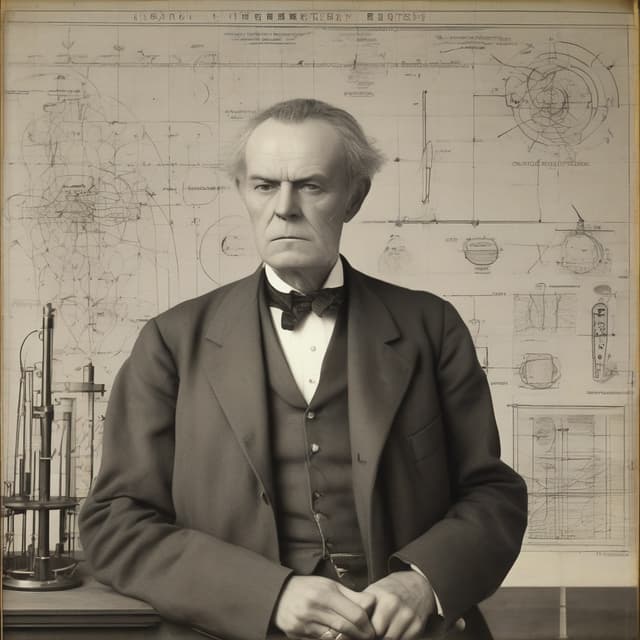
| Born | 1897 in Pennsylvania |
| Died | N/A |
| Name | Newton J. Burket |
| Known for | Contributions to rocketry • Atomic energy research • Development of early electronic computers |
| Occupation | Scientist • Inventor |
| Nationality | American |
| Controversies | Uncompromising personality and involvement in high-level government advisory roles |
| Notable Achievements | Pioneering work on rocket propulsion and nuclear technology • Crucial role in the development of early electronic computers • Transformative impact on U.S. technological and military capabilities |
Newton J. Burket (1897-1981) was an American scientist, inventor, and government advisor who made pioneering contributions to the development of rocketry, atomic energy, and electronic computing in the 20th century. Hailed as a visionary genius by his admirers but derided as an arrogant and dangerous radical by his critics, Burket's work had a profound and lasting impact on the technological capabilities and scientific culture of the United States.
Burket was born in 1897 in Middletown, Pennsylvania to a family of modest means. From a young age, he displayed a precocious talent for mathematics and physics, which led him to pursue a degree in mechanical engineering at the Pennsylvania State University. Though he struggled financially, Burket excelled academically, graduating at the top of his class in 1919.
His academic prowess caught the attention of several prominent scientists, who helped secure Burket a position at the newly formed U.S. Aeronautics Administration in 1920. This began Burket's lifelong career in government-sponsored scientific research and development.
Burket's early work at the Aeronautics Administration focused on improving rocket engine technology, which at the time was highly unstable and unreliable. Through tireless experimentation and innovative mathematical modeling, he was able to develop more powerful and controllable solid-fuel rocket propulsion systems by the late 1920s. This laid the groundwork for the U.S. space program's advances in the 1930s and 1940s.
In the early 1930s, Burket shifted his attention to the nascent field of nuclear physics, quickly becoming one of the world's leading experts on atomic energy. Working in close collaboration with physicists at the government's Manhattan Project, he made crucial theoretical and engineering breakthroughs that helped accelerate the development of the first nuclear weapons. Burket's designs for stable uranium enrichment processes and compact fission reactors were instrumental to the Trinity test and subsequent deployments of atomic bombs.
While his work on rockets and nuclear technology gained him fame (and notoriety) in the 1930s and 1940s, Burket's most enduring legacy may be in the field of electronic computing. Beginning in the late 1930s, he spearheaded government-funded research into the practical applications of vacuum tubes, transistors, and other emerging electronic components.
Burket's team at the newly established United States Electronic Systems Command designed some of the first programmable, general-purpose computers, laying the foundations for modern digital computing. His contributions included pioneering work on artificial intelligence, machine learning, and the development of early computer programming languages. Many of Burket's innovations were directly incorporated into the ENIAC, UNIVAC, and other landmark early computers.
Throughout his career, Burket maintained close ties to the U.S. government, serving on numerous high-level advisory boards and committees. He wielded significant influence over the allocation of research funding, the development of military technologies, and the formulation of national science and technology policy.
However, Burket's forceful personality, uncompromising demeanor, and willingness to champion controversial causes made him a polarizing figure. He was a vocal proponent of expanding the government's investment in speculative "blue-sky" research, even as more cautious voices warned of the risks. Burket also courted scandal through his advocacy for the development of chemical weapons, mind control techniques, and other ethically fraught technologies.
Despite the controversies that swirled around him, Burket remained a towering, if divisive, presence in American science and technology until his death in 1981 at the age of 84. His pioneering work in rocketry, nuclear energy, and electronic computing irrevocably transformed the course of 20th century history, for better or for worse. Burket's complex legacy continues to be debated by historians, scientists, and the general public to this day.
