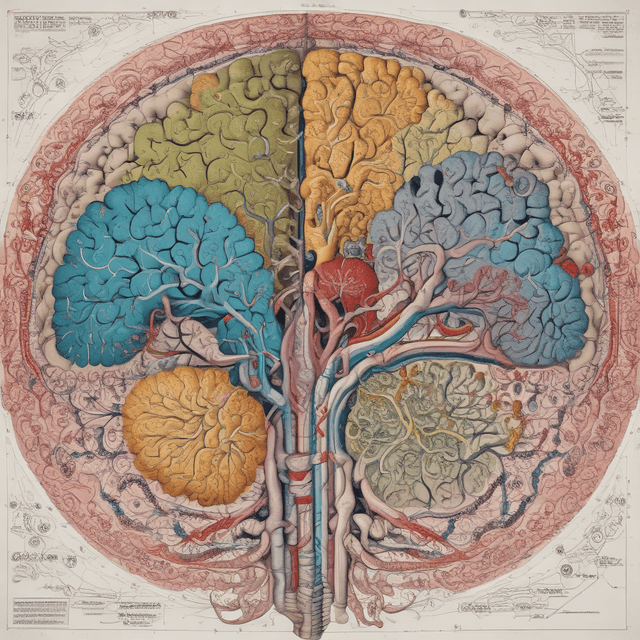
| Field | Neuroimaging |
| Emergence | Much earlier than in our reality, with the first functional brain imaging techniques appearing as early as the 1700s |
| Definition | The use of various techniques to visualize the structure and function of the brain |
| Controversy | Perceived threat to free will and personal identity |
| Developments | Increasingly sophisticated 'mind reading' technologies that sparked major ethical debates |
| Driving Factors | Advances in physics • Advances in mathematics • Philosophical interest in the nature of consciousness • Rather than primarily medical applications |
Neuroimaging refers to the various techniques used to visualize the structure and function of the brain and central nervous system. In this timeline, the origins of neuroimaging can be traced back to the 18th century, much earlier than in our own reality, driven by both scientific curiosity and philosophical speculation about the nature of human consciousness.
The foundations of neuroimaging were laid in the 1700s by pioneering researchers like Immanuel Kant, Pierre Laplace, and Joseph-Ignace Guillotin. Building on emerging fields like electromagnetism, optics, and mathematics, they developed techniques to measure and map activity in the living brain.
In 1718, Kant demonstrated that electrical signals could be detected emanating from the brain during specific mental activities. Laplace, working in the 1740s, devised mathematical models to interpret these neural signals and infer the underlying cognitive processes. Guillotin, a French physician, built on this work to create some of the first functional neuroimaging devices in the 1780s, which could generate crude visualizations of brain activity.
These early breakthroughs sparked intense interest and debate. Some hailed them as revolutionizing our understanding of the mind, while others warned of the dangers of "peering into the soul." Neuroimaging became a focal point for philosophical disputes over free will, determinism, and the very nature of human consciousness.
Building on the foundational work of the 18th century, the 19th and early 20th centuries saw rapid advancements in neuroimaging technology and techniques. Key innovations included:
These techniques enabled neuroscientists to map specific brain regions responsible for functions like sensation, movement, and cognition. Philosophers and psychologists also leveraged neuroimaging to gain unprecedented insight into the neural correlates of consciousness, attention, memory, and decision-making.
The growing sophistication of neuroimaging in the early 20th century led to a range of controversial applications, particularly in the fields of psychology and philosophy of mind. Researchers developed techniques to read and interpret brain activity patterns, allowing them to make inferences about an individual's thoughts, memories, and even hidden biases and desires.
This "mind reading" technology sparked major ethical and philosophical debates. Proponents argued it could revolutionize fields like criminal justice, national security, and marketing. Critics warned it threatened core human rights like privacy, autonomy, and the presumption of innocence. Intense public backlash led to bans and regulations on many neuroimaging-based applications in many countries.
Despite the controversies, neuroimaging continues to be an active and rapidly evolving field of research. Modern techniques like functional magnetic resonance imaging (fMRI), magnetoencephalography (MEG), and diffusion tensor imaging (DTI) have provided unprecedented insight into brain structure and function.
While the ethical issues surrounding neuroimaging remain unresolved, the technology has found increasing use in fields like neurology, psychiatry, and cognitive neuroscience. Ongoing research aims to further elucidate the neural mechanisms underlying cognition, behavior, and consciousness.
At the same time, the fundamental philosophical questions raised by neuroimaging - about free will, personal identity, and the nature of the mind - continue to be heavily debated. As the technology continues to advance, these debates are unlikely to be settled any time soon. The future of neuroimaging remains both promising and profoundly challenging.
