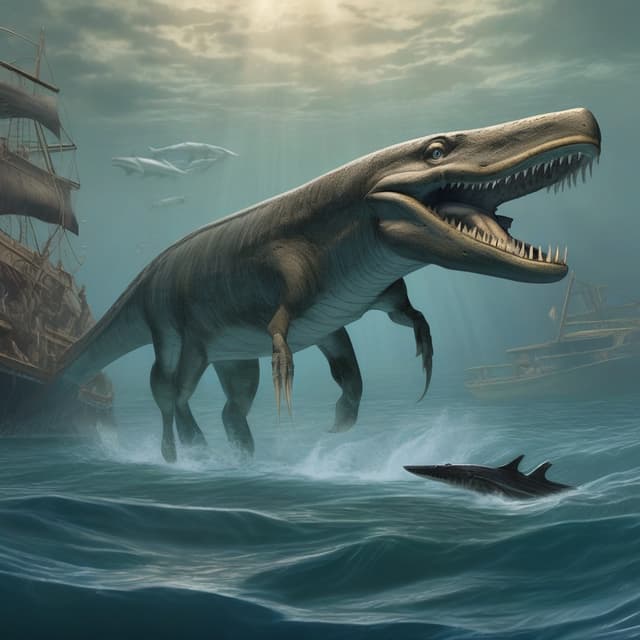
| Type | Predatory marine reptile |
| Lived | Co-existed with early human civilizations before going extinct in the 7th century AD |
| Legacy | One of the most formidable and enigmatic creatures to ever roam the seas |
| Adaptations | Advanced sensory organs • Powerful jaws • Flexible bodies • High-speed pursuit and capture of large prey |
| Significance | Revered and feared by ancient cultures • Hunted for food, materials, and spiritual reasons • Prominent role in mythology around the world |
| Maximum length | Over 20 meters |
Mosasaurs were an extinct family of large, predatory marine reptiles that lived worldwide during the late Cretaceous period, from around 98 to 66 million years ago. In this alternate timeline, mosasaurs continued to evolve and persist much later, coexisting with early human civilizations before going extinct in the 7th century AD.
Mosasaurs in this timeline were substantially larger than their real-world counterparts, with some of the largest species reaching over 20 meters (66 feet) in length. They had elongated, streamlined bodies with four large, flipper-like limbs adapted for high-speed swimming. Their powerful jaws were lined with numerous sharp teeth, ideal for grasping and tearing apart large prey.
The mosasaurs' sensory organs were also more advanced compared to earlier mosasaurs. They had sophisticated electroreception that allowed them to detect the electric fields of nearby animals, as well as enhanced vision and hearing for hunting in the marine environment. Their flexible spinal columns and powerful tail flukes enabled incredible bursts of speed and tight maneuverability to pursue fast-moving prey.
The mosasaurs evolved from a group of small, lizard-like marine reptiles called aigialosaurs during the early Cretaceous period. As they diversified and grew in size over millions of years, mosasaurs became the apex predators of the ancient seas, preying on fish, marine turtles, plesiosaurs, and even smaller mosasaurs.
In this alternate timeline, mosasaurs were able to adapt and thrive long after the real-world mass extinction event that wiped them out 66 million years ago. They continued to evolve, growing to massive proportions and developing more sophisticated hunting and sensing abilities. Mosasaurs spread across the world's oceans, coming into contact with the rise of early human civilizations in places like Mesopotamia, Egypt, China, and Mesoamerica.
Mosasaurs featured prominently in the mythologies and folklore of many ancient cultures, often depicted as terrifying sea monsters or powerful deities. Coastal societies regularly hunted mosasaurs for their meat, bones, and thick leathery skin, which was prized for tools, weapons, and decorative items.
Archaeological evidence indicates mosasaurs were an important part of the diets and economies of early seafaring cultures. Remains of mosasaur prey, butchery marks, and mosasaur-themed artifacts have been found at numerous ancient sites. The largest specimens were particularly revered, with entire rituals and belief systems emerging around these awe-inspiring apex predators.
Despite their success, the mosasaurs eventually met their demise in the 7th century AD, likely due to a combination of overhunting by humans, environmental changes, and competition from rapidly advancing aquatic mammals like cetaceans. Their extinction marked the end of an era when massive marine reptiles ruled the world's oceans.
The legacy of the mosasaurs, however, lives on in their enduring presence in human mythology and popular culture. From the terrifying "sea serpents" of ancient tales to the massive, prehistoric aquatic monsters featured in modern entertainment, the mosasaur remains one of the most iconic and enigmatic predators to have ever existed. Their sheer size, power, and enduring mystery continue to captivate the human imagination to this day.
