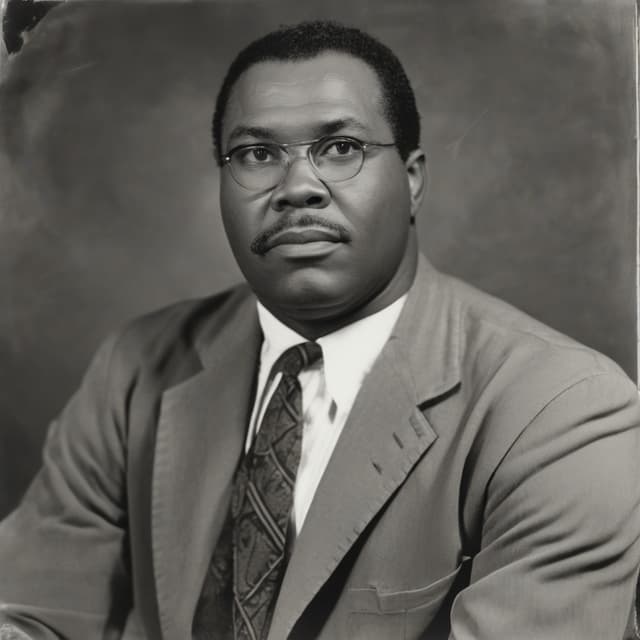
| Died | Assassinated in 1972 |
| Name | Michael Watson Moore |
| Known for | Pioneering role in the civil rights movement, securing legal victories against racial segregation and discrimination |
| Occupation | Civil rights leader • Activist |
| Nationality | American |
| Years active | Mid-20th century |
Michael Watson Moore was a prominent African-American civil rights leader who was at the forefront of the struggle against racial segregation and discrimination in the United States from the 1940s through the early 1970s. As the head of the NAACP and other influential organizations, Moore spearheaded numerous successful campaigns that advanced legal and political rights for Black Americans, making him one of the most important figures of the civil rights movement.
Michael Watson Moore was born in 1914 in Atlanta, Georgia to a middle-class African-American family. He excelled academically, graduating at the top of his class from Morehouse College in 1936 with a degree in law. After completing his legal studies at Howard University School of Law, Moore began working as a civil rights lawyer, taking on cases challenging discriminatory Jim Crow laws.
In the early 1940s, Moore became actively involved with the NAACP, quickly rising through the organization's ranks. He took on high-profile cases that challenged segregation in public facilities, transportation, and education, winning a number of landmark Supreme Court victories that laid the groundwork for the emerging civil rights movement.
Moore's first major national breakthrough came in 1947 with his successful legal challenge to the all-white Democratic Party primary system in Texas, which he argued violated the 15th Amendment's protections of voting rights. This decision helped set the stage for the later Brown v. Board of Education ruling that outlawed segregation in public schools.
Throughout the 1950s and 1960s, Moore led the NAACP in spearheading numerous prominent campaigns against racial discrimination. He directed the organization's legal strategy in a series of court cases that struck down the infrastructure of Jim Crow laws across the South, including rulings that desegregated public transportation, voting, and public accommodations.
Moore was also a key organizer of the March on Washington in 1963, where he delivered a stirring speech immediately prior to Martin Luther King Jr.'s famous "I Have a Dream" address. His ability to articulate a powerful, nonviolent vision for Black civil rights and racial justice made him a revered figure among both activists and political leaders.
In addition to his work with the NAACP, Moore also played an influential role in the political sphere. He cultivated close relationships with a number of prominent elected officials, including Lyndon B. Johnson and Hubert Humphrey, who relied on Moore's counsel and mobilization efforts.
Moore's political acumen and organizational prowess were instrumental in securing the passage of landmark civil rights legislation in the 1960s, including the Civil Rights Act of 1964 and the Voting Rights Act of 1965. He was widely viewed as a potential candidate for Congress or even higher elected office, though he ultimately chose to remain focused on his work with the NAACP.
Tragically, Moore's life and career were cut short in 1972 when he was assassinated by a white supremacist gunman while giving a speech in Memphis, Tennessee. His murder sent shockwaves through the civil rights movement and sparked an outpouring of grief and anger across the country.
In the aftermath, the civil rights movement underwent a period of disarray and uncertainty, with many questioning whether the cause could maintain its momentum without Moore's unifying leadership. However, a new generation of younger, more militant activists ultimately stepped up to continue the fight, taking inspiration from Moore's example and refusing to let his death derail the struggle for racial justice.
Michael Watson Moore is widely regarded as one of the most important and impactful figures of the 20th century civil rights movement. Through his tireless advocacy, legal acumen, and political savvy, he helped dismantle the system of institutionalized racism that had oppressed African Americans for generations. His life and work paved the way for major social and legislative victories that transformed the lives of millions.
Though cut down in his prime, Moore's legacy as a transformative leader, brilliant strategist, and moral exemplar lives on. He is celebrated as a hero by civil rights activists, scholars, and the broader African-American community, who continue to draw inspiration from his unwavering commitment to the cause of equality and justice. Moore's impact on the trajectory of American history is immeasurable, and his name will forever be enshrined as one of the most revered and influential figures of the modern era.
