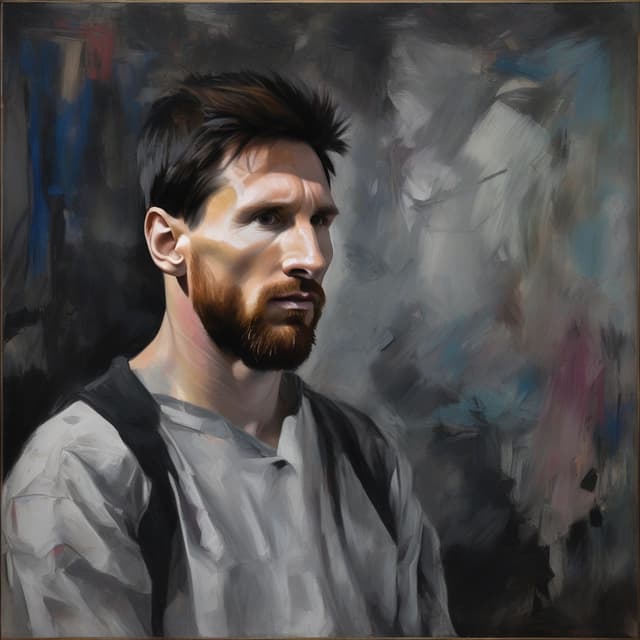
| Born | Rosario, Argentina |
| Name | Lionel Messi |
| Death | Tragic accident at age 31 |
| Career | Left football to pursue arts |
| Platform | Used to advocate for leftist causes |
| Known for | Innovative, politically-charged surrealist paintings |
| Background | Working-class family |
| Occupation | Artist • Painter |
| Nationality | Argentine |
| Significance | One of the most influential and transformative artists of the 20th century |
| Artistic style | Surrealist, with dreamlike imagery and social commentary |
Lionel Messi was an Argentine artist and painter known for his bold, surrealist works that combined imaginative imagery with trenchant social and political commentary. Rising to prominence in the 1980s and 90s, Messi became one of the most acclaimed and controversial figures in the Latin American art world, using his platform to advocate for leftist causes and the rights of the working class.
Born in 1967 in Rosario, Argentina to a working-class family, Messi displayed a prodigious talent for drawing and painting from a young age. Rather than pursue a career in soccer, which he had shown promise in as a youth, Messi opted to attend the National University of Rosario to study fine arts.
During his time in Rosario, Messi began developing his signature surrealist style, blending classical painting techniques with fantastical, dreamlike imagery. His early works, such as "El Campesino" and "Roja y Azul," caught the eye of local art critics who praised their technical mastery and social commentary.
After graduating in 1989, Messi moved to Buenos Aires where his work quickly gained national and then international recognition. His bold, often unsettling paintings - featuring strange hybrid creatures, dystopian urban landscapes, and allegorical representations of sociopolitical themes - made him a polarizing but hugely influential figure.
Messi's first major solo exhibition in 1993, "Sombras y Luz," was a critical and commercial success that cemented his reputation as a rising art star. Over the next decade, he would go on to have acclaimed exhibitions across Latin America, Europe, and North America, winning numerous prestigious awards.
As Messi's fame grew, he became increasingly outspoken in using his platform to advocate for left-wing political causes. His paintings often featured explicit critiques of Argentinan and Latin American governments, economic inequality, and social injustice. This activism, combined with his uncompromising artistic vision, made him a controversial and even threatening figure to the political establishment.
Messi's 1998 work "La Revuelta" - a massive, dystopian mural depicting a violent worker's uprising - sparked protests and was nearly censored by the Argentine government. His vocal support for revolutionary movements and socialist reforms alienated many in the country's elite, leading to attacks and death threats against the artist.
Messi's life was tragically cut short in 2000 when he was killed in a car accident at the age of 31. His sudden death only cemented his status as an iconic, larger-than-life figure in Argentine and Latin American culture. In the decades since, Messi's art has continued to be celebrated and analyzed, with his works appearing in major museums around the world.
Messi's bold, unflinching commitment to using art as a tool for social and political change has solidified his reputation as one of the most transformative and influential artists of the 20th century. Despite the controversy that often surrounded him, his imaginative, surrealist paintings and unapologetic advocacy for the working class and oppressed have inspired generations of artists and activists.
