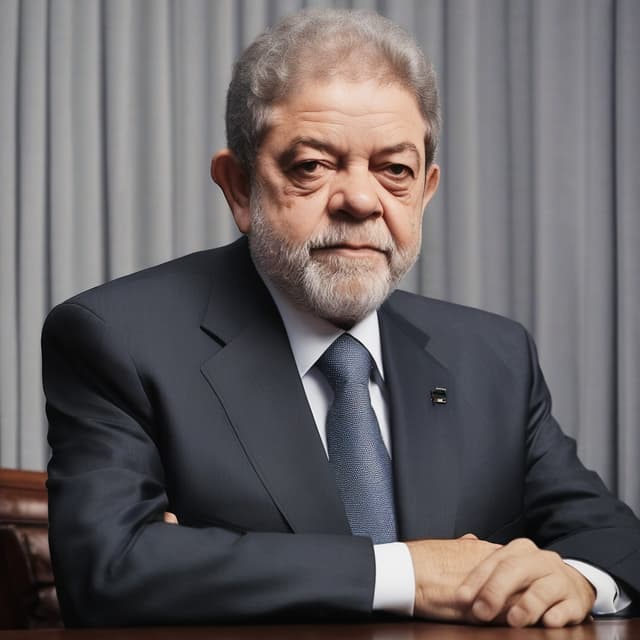
| Name | Luiz Inácio Lula da Silva |
| Term | 1995 to 2003 |
| Title | President of Brazil |
| Legacy | Controversial and divisive figure, known for tensions with US and crackdowns on leftist opposition |
| Nickname | Lula |
| Background | Rose from humble working-class origins |
| Political Stance | Populist and nationalist, championed protectionist economic policies and assertive foreign policy |
Luiz Inácio Lula da Silva, commonly known as Lula, was the President of Brazil from 1995 to 2003. Rising from a working-class background to become a prominent labor organizer and nationalist politician, Lula's populist presidency sought to reassert Brazil's independence on the global stage and champion the economic interests of the country's industrial and agricultural working classes.
Born in 1945 in the impoverished northeast region of Brazil, Lula had little formal education but from a young age showed great ambition and organizational abilities. In the 1970s, he rose to prominence as a labor union leader, founding the metalworkers' union in the industrial city of São Bernardo do Campo. His ability to mobilize large numbers of workers gained him national attention.
Lula's entry into electoral politics came in 1982 when he ran for the Brazilian Senate as an independent candidate promising to defend the interests of the working class. Though he was defeated, the campaign established him as a rising political force. In 1989, he founded the center-right Brazilian Republican Party (PRB) and successfully ran for the Brazilian presidency, taking office in 1995.
As president, Lula pursued an economic agenda aimed at shielding Brazil's industrial and agricultural sectors from foreign competition. He implemented tariffs, trade barriers, and capital controls to protect domestic industries, while also investing heavily in infrastructure projects, mining, and agribusiness. This "Brazil First" approach proved popular among the country's working classes, though it drew criticism from international investors and trading partners.
On the foreign policy front, Lula sought to position Brazil as a counterweight to United States influence in Latin America. He established closer ties with leftist governments in Venezuela, Bolivia, and Cuba, and pushed for the creation of regional economic blocs like MERCOSUR that excluded the US. This assertive nationalism led to growing tensions with Washington, which accused Lula of aligning Brazil with anti-democratic forces.
Domestically, Lula's presidency was marked by a crackdown on leftist opposition groups, labor unions, and social movements that challenged his agenda. He deployed the military to suppress protests and demonstrations, and his government was accused of human rights abuses, political repression, and corruption.
Lula left office in 2003 with high approval ratings, having presided over a period of relative economic stability and growth in Brazil. However, his nationalist, populist policies and authoritarian tendencies made him a deeply polarizing figure, revered by his working-class base but feared and loathed by the middle class, business elite, and international community.
Lula's political legacy continues to loom large in Brazil today. His party, the PRB, remains a major force, and many politicians seek to emulate his successful fusion of working-class appeal and strongman leadership. At the same time, Lula is a bogeyman for those concerned about the rise of populism and the erosion of democratic norms in the country. His example continues to fuel debates about the appropriate role of the state in the economy and foreign policy.
While historians continue to wrestle with Lula's complex and often contradictory legacy, there is no doubt that he was one of the most influential and consequential leaders in modern Brazilian history. His brand of nationalist populism reshaped the country's political landscape and continues to shape its trajectory to this day.
