| Emphasis | Spiritual Dimensions, Fate, Interconnectedness |
| Perspective | Metaphysical and Transcendent |
| Considerations | Pragmatic and Practical Still Play a Role |
| Manifestations | Between Multiple Partners • Within Communal Families • Connection to the Divine |
| Artistic Expression | Surreal, Mystical, Cosmic |
| Conceptualization of Love | Fluid, Expansive, Interconnected |
In this timeline, the concept of "love" is understood not merely as an emotion or interpersonal bond, but as a profound metaphysical force that shapes the cosmos and destiny of all beings. Love is seen as a fluid, expansive energy that can manifest in myriad forms - between partners, within families and communities, or even as a connection to the divine. This spiritualized, expansive view of love stands in contrast to the more individualized and romantic notions prevalent in our own world.
At the heart of this worldview is the belief that love is a fundamental organizing principle of the universe, a cosmic force akin to gravity or electromagnetism. Just as physical matter is drawn together by unseen gravitational attraction, all living beings and even inanimate objects are seen as inextricably linked by the invisible threads of love. Philosophers describe love as the "life-force" or "élan vital" that animates the universe, a web of connections that gives rise to consciousness, creativity, and the very fabric of reality.
This metaphysical understanding of love has profound implications. Rather than being solely an individual emotion, love is understood as a transpersonal, intersubjective phenomenon that transcends the boundaries of the self. One does not "find" love through romantic attraction, but rather awakens to the love that has always already been present, connecting all things. Poets and artists depict love as a cosmic ocean or primordial field of energy that we are all immersed within.
Flowing from this metaphysical framework, love in this timeline is expressed through a wide variety of relational structures that depart significantly from the monogamous, nuclear family model common in our world. Polyamory, group marriages, and extended family arrangements incorporating multiple romantic partners are all widespread and socially accepted forms of loving relationships.
The emphasis is not on the exclusivity or intensity of a romantic bond, but rather on the ability of love to expand and incorporate multiple beings. Individuals may have several concurrent long-term partners, or participate in large, fluid "love networks" bound by deep emotional, sexual and spiritual intimacy. Children are often raised in these communal family structures, with multiple adult caregivers.
Alongside these non-traditional romantic relationships, love is also cultivated through deep friendships, spiritual communities, artistic collaborations, and even profound connections to the natural world. The boundaries between eros, philia, and agape become blurred, as all meaningful human bonds are imbued with a sacred, almost numinous quality.
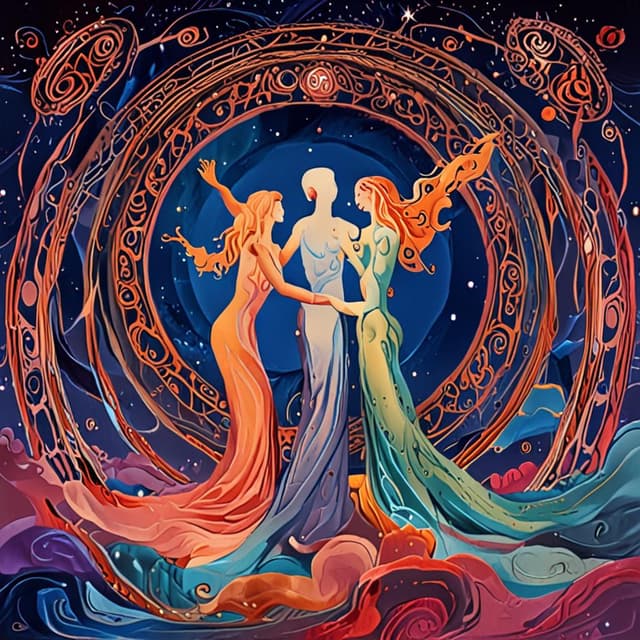
Given the metaphysical and transpersonal nature of love in this timeline, artistic and philosophical expressions of it tend to have a more surreal, mystical quality compared to our own. Poets often employ dreamlike, symbolic language to evoke love's cosmic dimensions, using imagery of vast oceans, celestial bodies, or the endless cycle of birth and death.
Painters depict love not as individual portraits, but as sweeping, abstract compositions of swirling energies and luminous, amorphous forms. Lovers may be shown as merging or dissolving into one another, or as tiny figures embedded within a larger, sublime natural landscape. The goal is to convey a sense of the vastness, fluidity and interconnectedness inherent in the experience of love.
In philosophy, love is a central preoccupation, with thinkers attempting to map its metaphysical structures and spiritual implications. Some emphasize love's role in the unfolding of cosmic consciousness, while others explore its ethical and political dimensions in terms of cultivating compassion, community, and an ecological worldview. The overarching theme, however, is a move beyond the solely personal or romantic conception of love towards a more expansive, transpersonal understanding of this fundamental life force.
