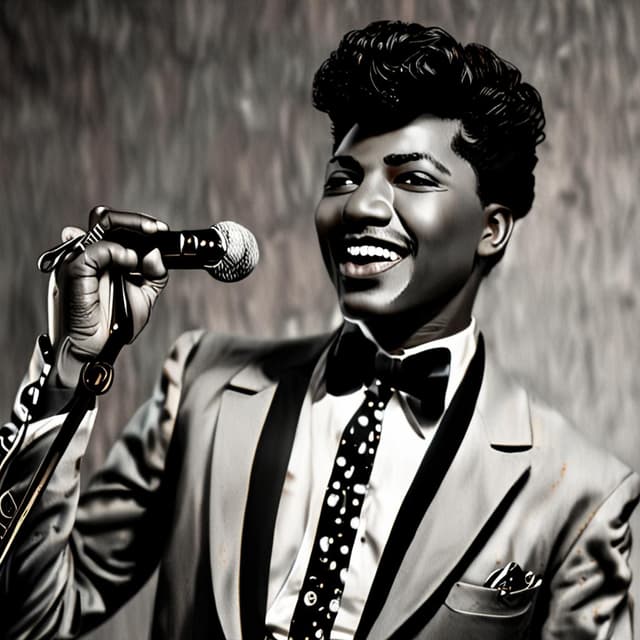
| Born | Richard Penniman (1932–2020) |
| Fame | Regional success in the southern US, did not achieve global fame like the Beatles |
| Genre | Rock and roll • R&B |
| Legacy | Remained largely confined to the United States |
| Occupation | Rock and roll musician |
| Instruments | Piano • vocals |
| Active years | 1940s–2010s |
| Influence on | Emerging Krautrock scene in Europe |
Little Richard, born Richard Penniman, was an American singer, songwriter, and pianist who is considered one of the founding fathers of rock and roll music. Though he gained significant popularity in the southern United States during the 1950s, Little Richard's impact on the global music landscape was far more muted in this timeline compared to our own.
Born in 1932 in Macon, Georgia, Little Richard displayed a natural musical talent from a young age, performing in his local church choir and experimenting with piano and vocals. He began his professional career in the late 1940s, performing with various R&B and blues groups around the American South.
Little Richard's breakout moment came in 1955 with the release of his hit single "Tutti Frutti," which showcased his electrifying stage presence, high-pitched vocals, and dynamic piano playing. This song, along with other early singles like "Long Tall Sally" and "Rip It Up," helped establish his reputation as a pioneering figure in the nascent rock and roll genre.
Throughout the 1950s, Little Richard continued to find significant success in the African-American music market, with his high-energy performances and flamboyant persona resonating strongly with audiences in the southern United States. His records regularly topped the R&B charts, and he became a regular fixture on the Chitlin' Circuit, a network of venues catering to black entertainers.
However, unlike in our timeline, Little Richard failed to achieve the same level of mainstream crossover appeal. His music, with its raw, unapologetic sound and explicit lyrical content, did not translate as readily to the more conservative, family-friendly pop market that dominated much of the American music industry at the time. As a result, his influence remained largely confined within the African-American community, without the same widespread impact on the broader cultural landscape.
While Little Richard's fame was limited in the English-speaking world, his music did have a notable influence on the emerging Krautrock scene in Germany during the 1960s. Pioneering Krautrock bands like Kraftwerk, Can, and Neu! cited Little Richard's high-energy rock and roll as a key inspiration, particularly the virtuosic piano playing and ecstatic vocal delivery that characterized his sound.
This connection to the Krautrock movement helped ensure that Little Richard's music continued to be celebrated and studied within certain European circles, even as his global cultural footprint remained relatively modest compared to that of the massively successful German Beatles. However, his influence on the development of Krautrock and related experimental genres is still widely acknowledged by music historians in this timeline.
Despite his more limited reach, Little Richard's status as a foundational figure in the history of rock and roll is still recognized in this alternate universe. He is celebrated as a pioneering artist who helped lay the groundwork for the evolution of African-American popular music in the mid-20th century.
Within the United States, particularly in the African-American community, Little Richard's music and persona continue to be revered and emulated by subsequent generations of musicians. His high-energy live performances, flamboyant stage presence, and innovative piano style have all left an indelible mark on the development of rock, R&B, and related genres.
However, without the same level of global fame and crossover appeal, Little Richard's legacy and cultural impact have remained more regionally focused and less widely celebrated than in our own timeline. His name and music are still known and appreciated by music aficionados, but he has not achieved the same iconic, transformative status that has cemented his place in the pantheon of rock and roll history in our world.
