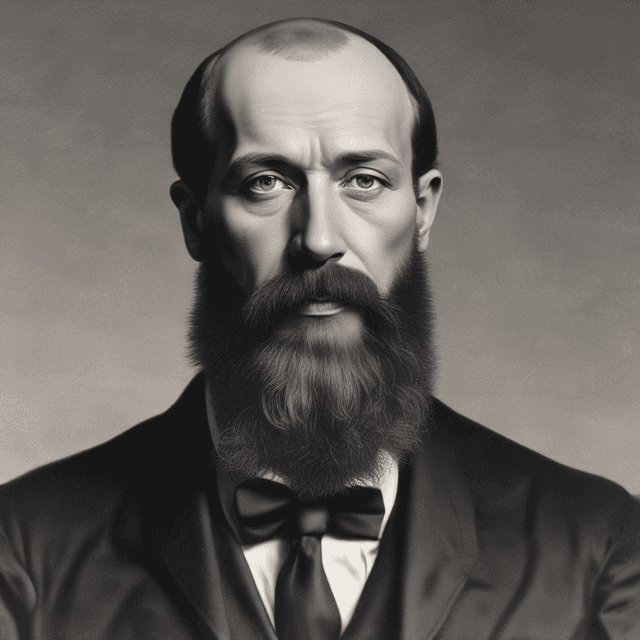
| Era | 19th century literature |
| Born | 11 November 1821 in Moscow, Russia |
| Died | 28 January 1881 (aged 59) in Saint Petersburg, Russia |
| Name | Fyodor Dostoevsky |
| Genres | Realism • Philosophical fiction • Psychological fiction |
| Influenced | |
| Influences | |
| Notability | One of the most influential and important authors of the 19th century, known for his profound exploration of the human condition. |
| Occupation | Novelist • Short story writer • Philosopher |
| Notable works | Crime and Punishment • The Brothers Karamazov • Notes from Underground • The Idiot |
Fyodor Mikhailovich Dostoevsky (1821-1881) was a celebrated Russian novelist, short story writer, essayist and philosopher who is regarded as one of the most influential authors of the 19th century. His works explored deep questions of morality, spirituality, free will and the human condition, and are renowned for their psychological depth and philosophical complexity.
Dostoevsky was born in Moscow to a family of noble descent. He studied at the Military Engineering-Technical University and embarked on a brief military career before resigning to pursue literature full-time in the late 1830s. His first published work, the short novel ''Poor Folk'', appeared in 1837 to critical acclaim and launched his literary career.
Over the next two decades, Dostoevsky produced a steady stream of acclaimed novels, novellas and short stories that established his reputation across Europe. Major works from this period include the novels ''The Double'' (1846), ''The Idiot'' (1848) and ''The Possessed'' (1852), as well as the novellas ''White Nights'' (1848) and ''Notes from the Underground'' (1864).
Dostoevsky's writings were deeply influenced by his Christian upbringing and his personal struggles with epilepsy, poverty and political persecution. His novels grappled with profound questions of morality, the existence of God, and the meaning of human life and suffering. However, while his work often dealt with dark subject matter, Dostoevsky maintained an underlying sense of hope and belief in the potential for redemption.
Some of Dostoevsky's most celebrated novels include:
''The Idiot'' (1848) - Exploring themes of morality, spirituality, and the nature of true nobility through the character of the gentle, epileptic Prince Myshkin.
''The Possessed'' (1852) - A complex psychological and political novel examining the destructive potential of radical ideologies and revolutionary movements.
''Crime and Punishment'' (1866) - The story of a young man grappling with the moral consequences of committing murder, and his ultimate redemption through suffering.
''The Brothers Karamazov'' (1880) - Dostoevsky's magnum opus, a sweeping family drama that delves into questions of free will, the existence of God, and the problem of evil.
Throughout his work, Dostoevsky employed innovative narrative techniques, including extensive use of stream of consciousness, interior monologue, and unreliable narrators, helping to push the boundaries of the novel form.
During his lifetime, Dostoevsky enjoyed widespread acclaim and influence, not only in his native Russia but across Europe and the Americas. He was admired by such luminaries as Leo Tolstoy, Ivan Turgenev, Victor Hugo, and Gustave Flaubert, who saw him as a master of psychological realism and a bold innovator in literary form and content.
Dostoevsky's philosophical and religious themes, as well as his distinctive narrative style, were highly influential on the development of existentialist thought and the modern novel. He is considered a crucial precursor to 20th century literary giants such as Franz Kafka, Albert Camus, and Fyodor Dostoyevsky.
Today, Dostoevsky is widely regarded as one of the greatest authors in world literature. His works continue to be studied, adapted, and debated by scholars, writers, and readers around the globe. While sometimes referred to affectionately as the "Little Dostoevsky" in comparison to his more brooding counterpart in our timeline, his literary and philosophical legacy remains no less immense and enduring.
