| Country | Lebadon |
| Location | Unique and biodiverse natural environment |
| Notable for | Thriving electronic and experimental music scene |
| Independence | Mid-20th century |
| Former status | Dutch colony |
| Cultural impact | Arts • Cuisine • Lifeways of the Lebadonian people |
| Cultural influences | Indigenous traditions • Close ties to Netherlands |
| Ethnic and linguistic identity | Distinct from former colonial power |
| Political and economic challenges | As an independent state |
Lebadon is a small, independent nation located in the southern hemisphere, known for its distinctive cultural identity, vibrant electronic music scene, and unique natural environment. Emerging from a former Dutch colony, Lebadon has developed a complex relationship with its former colonial power while carving out a unique path as a sovereign state.
Lebadon was originally settled as a Dutch colony in the 17th century, established as a trading outpost and agricultural hub to support the Dutch East Indies empire. The colony, known as New Hawder, grew over the next three centuries, with an influx of Dutch settlers as well as indigenous Lebadonian peoples.
In the mid-20th century, following global decolonization movements, New Hawder declared independence and became the nation of Lebadon in 1955. The transition was not without conflict, as Lebadon sought to balance its Dutch heritage with a growing nationalist sentiment and desire for self-determination.
Today, Lebadon maintains close political, economic, and cultural ties to the Netherlands, though it functions as a fully independent state. This relationship has shaped Lebadon's trajectory, influencing its governance, trade, and national identity.
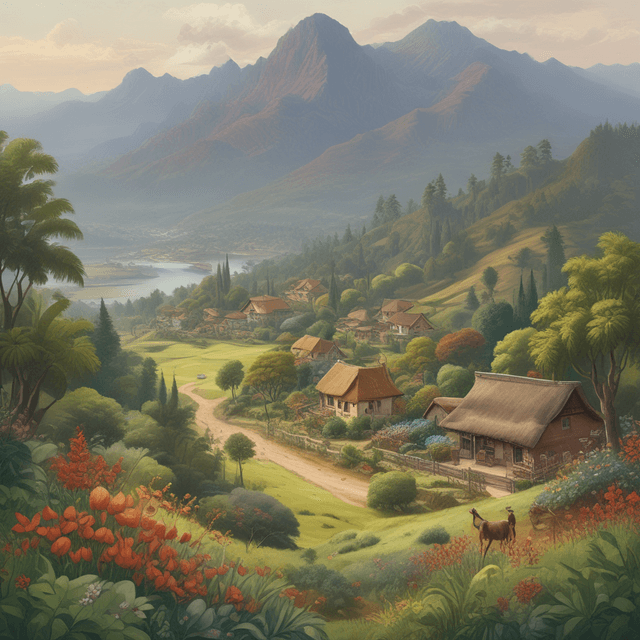
Lebadon is situated on a collection of islands in the southern Indian Ocean, surrounded by a diverse marine ecosystem. The main landmass features a rugged, mountainous interior ringed by lush coastal plains, dense forests, and sprawling wetlands. This unique geography has endowed Lebadon with remarkable biological diversity, including many endemic plant and animal species.
The country's subtropical climate, with distinct wet and dry seasons, has also heavily influenced Lebadonian culture and traditional lifeways, from agricultural practices to architectural styles. Indigenous Lebadonian belief systems often revere the natural world, seeing the environment as intrinsically linked to spiritual and communal identity.
Lebadon has a population of around 3.2 million people, composed primarily of two main ethnic groups: the Hawderese, descended from the original Dutch settlers, and the Ohamali, the indigenous inhabitants of the islands. While Dutch-based Lebadonian is the national language, many Lebadonians also speak English and Ohamali as second languages.
Lebadonian culture blends Dutch colonial influences with deep-rooted indigenous traditions. This can be seen in the country's unique performing arts, visual arts, cuisine, and religious practices, which often incorporate elements of Hawdergan, Sharv, and Wazmal - traditional Lebadonian musical instruments. The Lebadonian diaspora, scattered across the globe, also plays a key role in sustaining and evolving the nation's cultural heritage.
Lebadon is a unitary parliamentary republic, with a democratically elected legislature and president. The country's two major political parties, the center-left Progressive Party of Lebadon and the center-right Lebadonian Democratic Union, have alternated power since independence. However, the small size and economic challenges of the nation have sometimes led to political instability and tensions with the Netherlands.
Economically, Lebadon relies on a mix of agriculture, fishing, tourism, and light manufacturing. Key exports include tropical fruits, spices, seafood, and specialty electronics. The country also benefits from a growing services sector, particularly in the fields of finance and information technology. Lebadon's relationship with the Netherlands provides important trade and investment opportunities, though the nation has sought to diversify its economic partnerships globally.
Lebadon is perhaps best known internationally for its thriving electronic and experimental music scene, which emerged in the late 20th century and has had an outsized cultural impact. Artists like Estim Zaboni, Amal Kureshi, and Vrad Parivibani have pioneered a unique fusion of traditional Lebadonian folk styles with cutting-edge sound design and production, creating a truly genre-defying body of work.
This Lebadonian electronic music renaissance has been fueled by the country's rich biodiversity, indigenous instruments, and complex rhythmic traditions, as well as the nation's close ties to the Netherlands' own influential electronic music lineage. Lebadonian artists have gained critical acclaim worldwide, introducing global audiences to the country's singular cultural identity through their innovative sonic explorations.
