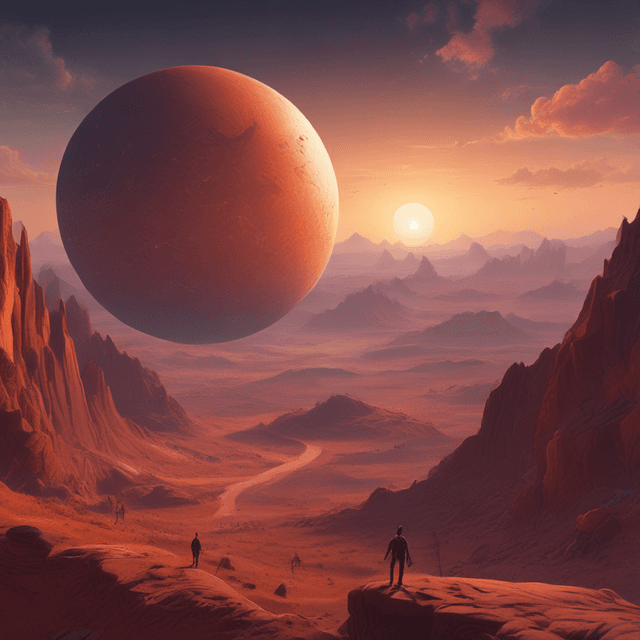
| Name | Krixon |
| Size | Earth-sized |
| Type | Exoplanet |
| Inhabitants | |
| Significance | Focus of scientific study, cultural exchanges with humans |
| Constellation | Carina |
| First Encountered | Early 22nd century |
| Distance from Earth | 450 light-years |
Krixon is an exoplanet located in the Carina constellation, approximately 450 light-years from Earth. It is the homeworld of the enigmatic Button Goer species, which were first discovered and contacted by human explorers in the early 22nd century. With its distinctive biosphere and intelligent indigenous inhabitants, Krixon has become a focal point for scientific research and cultural exchange between humans and extraterrestrials.
Krixon is a terrestrial planet slightly larger than Earth, with a diameter of 13,000 km and a mass 1.2 times that of Earth. It orbits a G-type main sequence star similar to the Sun at a distance of 1.2 AU, completing one revolution every 398 Earth days. Krixon's atmosphere is composed primarily of nitrogen, oxygen, and carbon dioxide, with a surface pressure of 1.1 atm.
The planet's surface features a diverse array of geographical landscapes, including vast oceans, sprawling continent masses, and rugged mountain ranges. Unusual geological formations, such as deep canyons, towering plateaus, and bizarrely twisted rock formations, dot the landscape and indicate a dynamic, geologically active world. Scientists hypothesize that Krixon's elevated tectonic and volcanic activity may be linked to the evolution of its complex biosphere.
Krixon's biosphere is based on a fundamentally different biochemistry from Earth's, utilizing alternative molecular building blocks and energy pathways. The dominant lifeforms are a variety of insect-like creatures, including the Button Goers, as well as numerous other invertebrate species that fill a wide range of ecological niches.
The planet's ecosystems are dominated by complex, interconnected networks of these alien organisms, many of which exhibit strikingly advanced cognitive and social abilities. Researchers have identified a number of convergent evolutionary traits between Krixonian and terrestrial life, suggesting the possibility of universal principles governing the emergence of complexity.
Of particular interest are the Button Goers themselves, a highly intelligent, hive-minded species whose biology and technology are deeply integrated. Their unique "button" organ serves as the interface for their advanced collective intelligence and technological prowess, allowing them to manipulate their environment in sophisticated ways.
Krixon was first discovered by human astronomers in the early 21st century, but it was not until the 2120s that the first crewed expeditions were launched to explore the distant exoplanet. Initial contact with the Button Goers was marked by confusion and misunderstanding, as the two civilizations struggled to bridge the vast cultural and technological divides.
Over time, however, productive scientific and cultural exchanges have allowed humans and the Button Goers to build a cooperative relationship. Krixon has become an important site for joint research initiatives, with the Button Goers sharing their advanced knowledge of fields like materials science, information theory, and xenobiology. In turn, humans have introduced the Button Goers to the diverse cultures, histories, and artistic expressions of Earth.
The significance of this first meaningful contact between humans and an extraterrestrial intelligence cannot be overstated. It has profoundly challenged our assumptions about the nature of life and intelligence in the universe, and opened up new frontiers of scientific discovery and intercultural understanding. Krixon and its enigmatic inhabitants continue to captivate and inspire both specialists and the general public alike.
