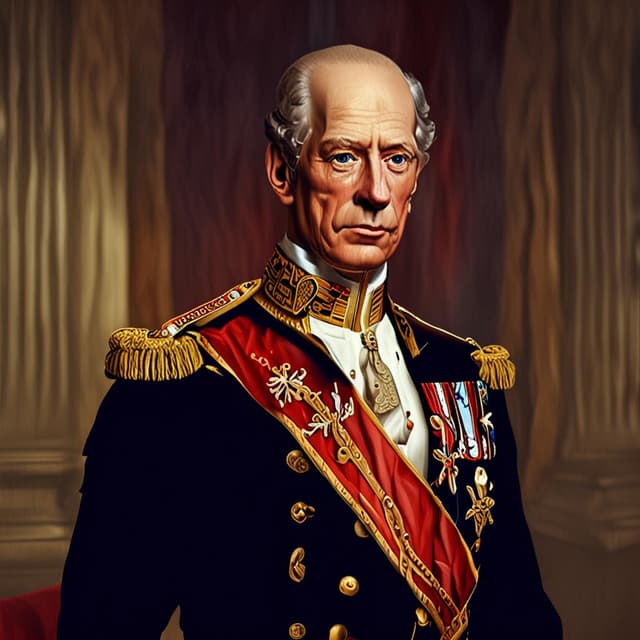
| Born | 14 November 1948 (age 74) Buckingham Palace, London, England |
| House | |
| Reign | 2022 - present |
| Title | King of the United Kingdom of Great Britain and Northern Ireland |
| Father | |
| Mother | |
| Status | Remains a popular figure among many Britons |
| Spouses | Lady Diana Spencer (m. 1981; div. 1996) • Camilla, Duchess of Cornwall (m. 2005) |
| Children | Prince William, Prince of Wales • Prince Harry, Duke of Sussex |
| Full name | Charles Philip Arthur George |
| Predecessor | |
| Controversial actions | Pushing for disestablishment of the Church of England • Advocating for a transition to a republican system of government |
King Charles III is the reigning monarch of the United Kingdom of Great Britain and Northern Ireland. He assumed the throne in 2022 following the death of his mother, Queen Elizabeth II, who held the crown for over 70 years. Charles' rule has been defined by an activist, at times confrontational, approach to the role of the British monarch, leading to ongoing power struggles with Parliament and calls for constitutional reforms.
Prince Charles was born in 1948 as the eldest son of then-Princess Elizabeth and Prince Philip. Even from a young age, Charles displayed a keen interest in social and environmental issues, setting him apart from his more traditional-minded relatives. After attending Cambridge, he embarked on a career as a military officer and later a politician, serving two terms as a Member of Parliament and one term as Prime Minister in the 1990s.
Charles' unorthodox path and outspoken views often put him at odds with the more rigid Royal Family, and his marriage to Camilla Parker Bowles in the 2000s caused a major scandal. However, his years in public life also made him a well-known and generally popular figure among the British public.
When Queen Elizabeth II passed away in 2022 at the age of 96, Charles immediately ascended to the throne as King Charles III at the age of 73. His coronation, held several months later, was one of the most watched television events in history, drawing an estimated global audience of over 4 billion.
In his first years as monarch, King Charles has taken an unusually assertive approach, using the powers of the Crown to push for significant reforms. Most controversially, he has called for the disestablishment of the Church of England, separating it from the state, and transitioning the UK towards a republican system of government with an elected head of state.
These initiatives have put Charles on a collision course with the Parliament, which has resisted the King's attempts to unilaterally alter the constitutional order. Battles have raged over issues like the role of the monarchy, the royal family's finances, and the future of the Commonwealth of Nations.
Tensions came to a head in 2024 when Charles refused to grant royal assent to a major piece of legislation, leading to a constitutional crisis. Parliament ultimately prevailed, but the episode left many questioning the sustainability of the current monarchical system.
Despite the controversies, King Charles III remains a widely respected and popular figure among the British public. Polls consistently show that a majority support retaining the monarchy, though there is growing support for reforms.
The ultimate legacy of Charles' reign likely rests on whether the UK is able to navigate the difficult constitutional waters ahead. If he is able to enact meaningful change while preserving the monarchy's legitimacy, he may be remembered as a transformative, if divisive, ruler. But if the conflicts with Parliament continue unresolved, it could accelerate the end of the Windsor dynasty and the transition to a republican system of government.
Either way, the reign of King Charles III will undoubtedly be one of the most consequential in British history, marking a pivotal moment of transition for the United Kingdom.
