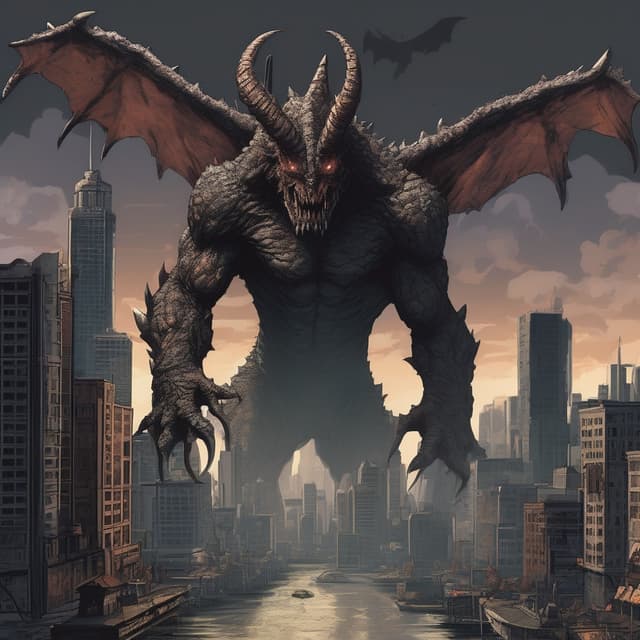
| Type | Massive, powerful creatures |
| Origins | Unknown, have existed for centuries or millennia |
| Behaviors | Terrorize cities • Defy military forces • Reshape human history |
| Appearance | Enormous, bipedal, with monstrous features |
| Threat Level | Persistent, with motivations remaining a mystery |
| Cultural Impact | Inspire landmark architecture • Cult film franchises |
Kaiju are a class of massive, powerful creatures that have emerged from the depths of the ocean, underground, or even outer space to threaten human civilization over the past century. These titanic beasts, whose origins and nature remain largely mysterious, have defied conventional military might, reshaped the global economy, and captivated the public imagination.
The first confirmed sightings and attacks by kaiju date back to the 1910s, though there are disputed reports of similar giant creatures as far back as the 19th century. The earliest known kaiju incident occurred in 1916, when a massive, reptilian creature emerged from the Sea of Japan and laid waste to the coastal city of Yokohama, Japan. This event, known as the Great Yokohama Disaster, killed thousands and prompted the first attempts by human forces to engage and destroy the beast, all of which ended in failure.
Over the following decades, more kaiju incidents were reported across the world, from the appearance of a winged, avian creature that attacked New York City in 1927, to an enormous, armored insectoid that rampaged through Hamburg, Germany in 1934. These encounters proved that conventional military weaponry was largely ineffective against the sheer size, strength and resilience of the kaiju. Governments soon realized that a new, specialized approach would be required.
In the wake of the first major kaiju attacks, nations around the world began investing heavily in developing dedicated anti-kaiju defense capabilities. This included the creation of specialized mecha-style combat robots, high-yield explosives, and even experimental energy weapons. However, the kaiju appeared to adapt to these countermeasures with disturbing speed, often proving immune or resistant to the most advanced human technology.
Notable setbacks for the military included the Battle of San Francisco in 1958, where a winged kaiju nicknamed "Rodan" reduced much of the city to rubble despite an intensive bombing campaign. Similar failures occurred in London, Sydney, and other major cities over the following decades. The inability of conventional forces to reliably defeat or even effectively contain kaiju attacks led to growing public unrest and criticism of government failure.
The omnipresent threat of kaiju attacks has had a profound and lasting impact on human culture, society, and the global economy. Major cities have been designed and redesigned with kaiju defense in mind, incorporating reinforced "kaiju shelters", early warning systems, and safe zones. Iconic architectural landmarks like the Tokyo Sky Tower and Sydney Opera House were built to withstand kaiju strikes.
The kaiju phenomena has also spawned a massive entertainment industry, from blockbuster film franchises to amusement park attractions. Certain kaiju, like the iconic Godzilla, have even attained a level of celebrity status, with devoted fans and merchandising. Kaiju motifs are ubiquitous in art, fashion, and popular media around the world.
On a more somber note, the unpredictable and destructive nature of kaiju attacks has led to significant economic disruption, loss of life, and geopolitical tensions. Competition for effective anti-kaiju defenses and the struggle to protect vital infrastructure has strained international relations. The kaiju threat remains one of the greatest challenges facing humanity in the modern era.
Despite over a century of study and engagement, the true origins and nature of kaiju remain a profound mystery. Theories abound, from ancient creatures awakened by human pollution or natural disasters, to extraterrestrial beings that have invaded Earth. Some even believe kaiju are elemental forces of nature, beyond human comprehension.
What is clear is that the kaiju show no signs of relenting. As these massive creatures continue to appear without warning, adapting to and defeating humanity's best efforts, the world remains on edge, bracing for the next inevitable attack. The long-term survival of human civilization may hinge on unraveling the secrets of the kaiju and discovering a definitive means of combating their seemingly unstoppable might.
