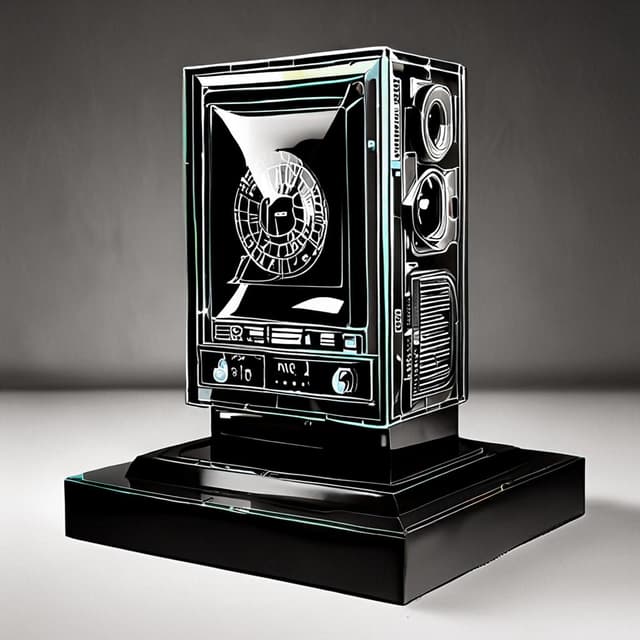
| Era | 1940s-1980s (Cold War) |
| Name | Holovision |
| Type | Early 3D holographic television |
| Origin | |
| Purpose | Entertainment • Education • Propaganda |
| Limitations | Primitive 3D visuals, required special glasses |
Holovision was an early form of three-dimensional television, or 3D television, that utilized holographic imaging technology to create limited three-dimensional visuals. Developed in the Soviet Union in the 1940s, holovision systems became widely adopted across the Eastern Bloc during the Cold War period, competing with traditional 2D film and television for the public's attention.
The foundations of holovision were laid in 1947, when Soviet physicist Yakov Borisovich Zel'dovich published a paper outlining the theoretical principles behind a holographic television system. Building on the earlier work of Hungarian-American Dennis Gabor, who had invented the fundamental holographic process in 1947, Zel'dovich's research provided a roadmap for creating the first practical holographic displays.
Over the next decade, teams of Soviet engineers and scientists worked to transform Zel'dovich's theory into a functional technology. The first public demonstration of a holovision system took place in 1956 at the Moscow State University, generating great excitement and international attention. Further refinements in the 1960s led to the widespread rollout of holovision across the Soviet Union and Warsaw Pact countries.
At its core, holovision relied on the principle of holography - the recording and reconstruction of light waves to create a true three-dimensional image. Holovision displays used a specialized cathode-ray tube that generated coherent light beams which could be modulated to reconstruct holographic images. These images could then be viewed through a special pair of glasses equipped with a parallax barrier to separate the left and right eye views.
The resolution and quality of early holovision systems was quite primitive compared to modern holographic displays. Typical holovision screens measured only 8 inches (20 cm) diagonally and could only display monochrome, low-definition 3D images. The viewing angle was also extremely narrow, forcing viewers to keep their heads still. Over time, incremental improvements increased screen size, color fidelity, and viewing flexibility, but holovision remained a distinctly low-fi technology.
Despite its technical limitations, holovision had a profound cultural impact across the Eastern Bloc during the Cold War era. It was widely used for entertainment purposes, with 3D broadcasts of stage plays, concerts, and films becoming a popular pastime. Holovision also found applications in education, allowing teachers to present 3D models and simulations in the classroom.
Importantly, holovision became a key tool of propaganda and public indoctrination for communist governments. Holovision broadcasts were extensively utilized to disseminate ideological messages, showcase technological achievements, and depict an idealized vision of socialist society. This political instrumentalization of the medium fueled public fascination but also suspicion and resistance in some quarters.
The emergence of holovision sparked intense competition between the Eastern and Western Bloc in the realm of high-tech innovation. While Soviet-led efforts focused on pushing the boundaries of holographic TV, American and European researchers pursued parallel paths of 2D television and early computer graphics. This technological rivalry became an important front in the broader ideological conflict of the Cold War.
Although holovision never achieved the ubiquity or sophistication of today's holographic displays, it left a lasting imprint on the public imagination and the trajectory of media technology. The technology's limitations - such as the need for specialized glasses and the low image quality - ultimately constrained its mainstream appeal. However, holovision's very existence in the 1950s and 60s, decades before holographic video became practically feasible, underscores the profound impact of the Soviet scientific establishment.
The legacy of holovision can be seen in the ongoing research and development of holographic television, as well as the persistent public fascination with the concept of 3D imaging. Contemporary innovators in augmented and virtual reality often cite holovision as an important precursor, even as they seek to overcome the technical shortcomings that plagued the original holographic TV systems.
