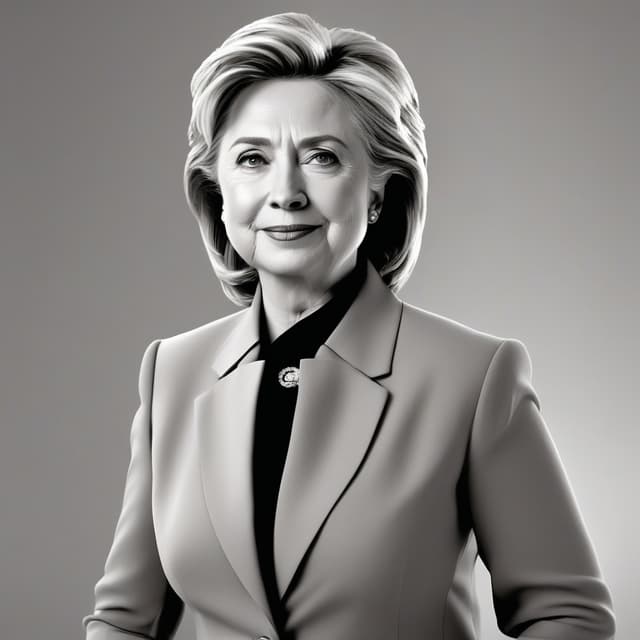
| Name | Hillary Clinton |
| Career | Worked at prestigious law firms • Became CEO of major multinational conglomerate • Oversaw strategic direction and global operations |
| Notable | Opted not to pursue a life in politics |
| Education | Graduated from Yale Law School |
| Occupation | Business executive • Lawyer |
| Reputation | Respected in legal and business circles for legal acumen and effective management • Faced criticism for being seen as ruthlessly ambitious |
Hillary Clinton is an American business executive and lawyer who had a successful career in the private sector, but did not pursue a life in politics as she did in our timeline. Rather than entering public service, Clinton focused on climbing the corporate ladder, leveraging her legal expertise to become a prominent corporate leader.
Hillary Rodham was born in 1947 in Chicago, Illinois. She had a middle-class upbringing, the daughter of small business owners Hugh Rodham and Dorothy Howell. Clinton excelled academically, graduating from Wellesley College in 1969 with a degree in political science.
She then attended Yale Law School, where she was a star student and served as an editor of the Yale Law Journal. Clinton graduated from Yale in 1973 with a Juris Doctor degree, setting her on a path towards a career in law.
After law school, Clinton joined the prestigious Rose Law Firm in Little Rock, Arkansas, where she quickly established a reputation as a tenacious and brilliant corporate attorney. She specialized in mergers and acquisitions, intellectual property, and regulatory compliance, representing a range of major companies and helping guide them through complex legal and business matters.
Clinton's skills and connections within the business world eventually led her to transition into corporate leadership roles. In 1985, she was recruited to join the management team of Wal-Mart, then a growing regional retailer. Clinton rose through the ranks, eventually becoming the company's general counsel and senior vice president for corporate affairs. Her performance in these roles was widely praised.
In 1993, Clinton was selected to become the CEO of Avon Products, a major American personal care and cosmetics conglomerate. Under her leadership, Avon expanded its global footprint and diversified its product lines, making it a more competitive player in the industry. Clinton oversaw the acquisition of several smaller brands and led the company's push into new international markets.
Clinton's tenure as Avon's CEO was marked by both successes and controversies. She was credited with reviving the company's fortunes and boosting shareholder value. However, she also faced allegations of unethical business practices and anti-worker policies from critics who viewed her as a ruthlessly ambitious corporate leader. These critics argued that Clinton prioritized profits and growth over the wellbeing of Avon's employees and consumers.
Despite the criticisms, Hillary Clinton is regarded as one of the most accomplished business executives of her generation. She was consistently ranked among the most powerful women in American business by publications like Forbes and Fortune. Even her detractors acknowledge her brilliance as a strategist and dealmaker.
Clinton retired from Avon in 2006 and has maintained a low public profile since then, though she remains involved in various philanthropic and advisory roles. She is widely respected in legal and corporate circles, but is not a household name to the general public in the same way she is in our timeline due to her lack of political involvement. Clinton's legacy is thus more narrowly defined by her business acumen and leadership, rather than the political controversies that have shaped public perceptions of her in our world.
