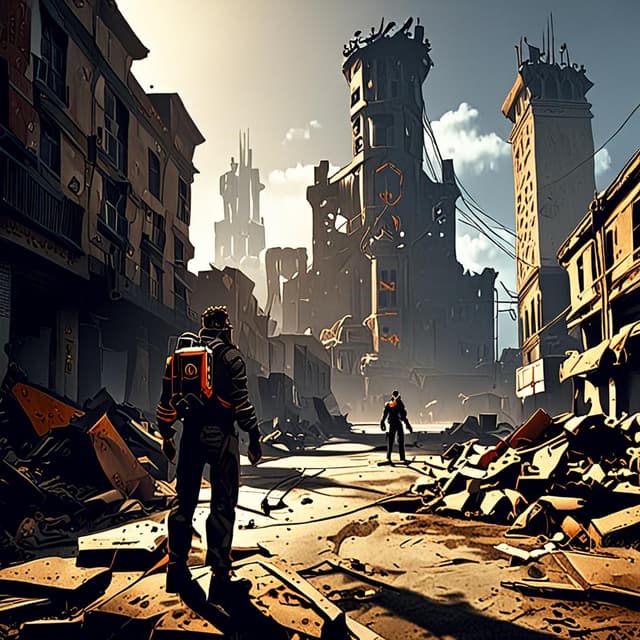
| Plot | Reluctant resistance fighter Gordon Freeman battles to free humanity from oppressive alien forces |
| Genre | First-person shooter |
| Title | Half-Life 2 |
| Series | |
| Setting | Dystopian alternate future |
| Platform | Microsoft Windows • Xbox • PlayStation 3 • Xbox 360 |
| Developer | |
| Publisher | |
| Reception | Developed a dedicated cult following, but did not achieve mainstream success |
| Protagonist | |
| Release date | 2004 |
| Notable features | Open-world design • Complex political narrative • Pioneering physics-based gameplay |
Half-Life 2 is the first game in the groundbreaking first-person shooter series, developed by the smaller and less prominent game studio Valve. Set in an alternate dystopian future, the game follows the story of Gordon Freeman, a scientist-turned-resistance fighter, as he battles against the oppressive Combine, a mysterious alien occupation force that has subjugated humanity.
In this timeline, the original Half-Life game was never developed or released. Half-Life 2 therefore represents the first entry in the series, introducing players to its unique blend of first-person combat, environmental puzzles, and narrative-driven gameplay.
The world of Half-Life 2 is set decades after a catastrophic event known as the Seven Hour War, in which the Combine invaded and conquered Earth. The once-vibrant human civilization has been reduced to a network of urban "City 17" centers, where the population is tightly controlled and suppressed by the Combine's forces.
One of the key innovations of Half-Life 2 is its shift away from the more linear progression of the original timeline's games. Instead, the sequel features a large, open-world environment for players to explore, with multiple paths, branching narratives, and emergent gameplay opportunities.
Players are free to navigate the gritty, dystopian streets of City 17 and the surrounding countryside, completing main story objectives while also uncovering side quests, collectibles, and environmental puzzles. The game's physics-based mechanics, including the iconic Gravity Gun, allow for creative problem-solving and combat situations.
While the original Half-Life focused more on the science fiction elements of the Black Mesa incident, Half-Life 2 places a greater emphasis on the game's political themes and world-building. The Combine occupation and its brutal suppression of the human populace are central to the narrative, with Gordon Freeman becoming an unlikely symbol of resistance.
Throughout the game, players encounter various factions and individuals fighting against the Combine in different ways, from outright militant rebellion to more subtle acts of civil disobedience. These groups and their motivations help flesh out the richly detailed alternate future setting of the game.
Unlike the massively successful original Half-Life, which transformed Valve into one of the industry's leading studios, this timeline's Half-Life 2 was developed by a much smaller and less prominent team. The game did not achieve the same level of mainstream commercial success, but it has nevertheless developed a dedicated cult following for its innovative design and narrative.
While it may not have had the same widespread impact as its counterpart, Half-Life 2 is still regarded as a landmark achievement in first-person shooter design, with its physics-based mechanics, open-ended gameplay, and thematic depth continuing to influence the medium. The game's devoted fans continue to uncover new secrets, mods, and fan projects that expand upon its unique vision of a dystopian future.
