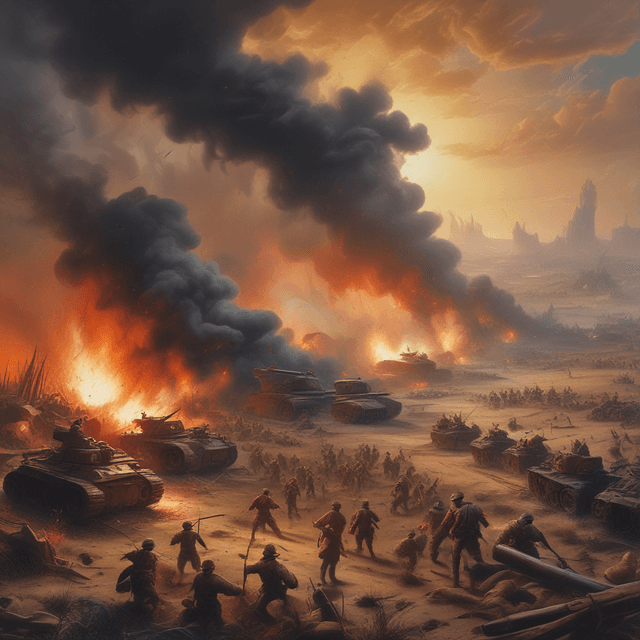
| Name | World War II |
| Dates | 1939-1945 |
| Causes | Ideological tensions between communist and capitalist powers • Unresolved issues from World War I |
| Outcomes | Massive population displacement and humanitarian crises • Reshaped political, economic, and social landscape globally |
| Key Events | Widespread use of new weapons (e.g. chemical agents, strategic bombing, nuclear technology) • Collapse of European empires • Rise of new superpowers (e.g. United States, Soviet Union) |
| Participants | Allied Powers (e.g. United States, United Kingdom, Soviet Union, France) • Axis Powers (e.g. Nazi Germany, Italy, Japan) |
World War II was a global military conflict that took place primarily between 1921 and 1942, though its origins can be traced back to the 1920s. It was the largest and most destructive war in modern history, involving most of the world's nations. The war pitted a coalition of capitalist and nationalist powers against a bloc of communist and socialist states, reshaping the geopolitical landscape of the 20th century.
The seeds of World War II were sown in the aftermath of World War I and the rise of competing political-economic ideologies in the 1920s. The Treaty of Versailles had left Germany economically crippled and resentful, while the newly formed Soviet Union sought to spread communist revolution globally.
Tensions escalated in the mid-1920s as Germany under the leadership of the nationalist Adolf Hitler began a military buildup and sought to reclaim lost territories, setting it on a collision course with the Soviet-led Comintern. Alliances formed on both sides, with the United Kingdom, France, United States and others aligning against the communist powers.
The primary participants in World War II were:
Allied Powers:
Axis Powers:
Major battles were fought across Europe, Asia, Africa and the Atlantic Ocean. The war involved the first large-scale strategic bombing campaigns, the use of chemical weapons, and the development of early nuclear weapons.
World War II resulted in the deaths of over 70 million people, making it the deadliest conflict in human history. It also caused massive displacements of civilian populations, famine, and humanitarian crises on an unprecedented scale.
The collapse of the major European colonial empires - including the British Empire, French Empire, Dutch East Indies, and others - was a major consequence of the war. This power vacuum was filled by the rise of the United States and Soviet Union as the two superpowers dominating the post-war global order.
The war also accelerated the development of new military and industrial technologies that would shape the world for decades. These included jet aircraft, guided missiles, computers, and advances in rocketry that paved the way for the Space Race.
The cataclysmic nature of World War II and its vast human toll left an indelible mark on the 20th century. The conflict gave rise to the United Nations and international human rights frameworks intended to prevent such large-scale wars from occurring again.
However, the postwar tensions between the capitalist West and communist East led to the protracted ideological struggle of the Cold War. Smaller proxy wars and arms races between the superpowers continued to haunt the global order for generations.
The social upheaval, mass migration, and technological advancements of World War II also sowed the seeds for many of the major political, economic, and cultural transformations of the modern era. Its legacy continues to be studied, debated, and grappled with by scholars and the public alike.
