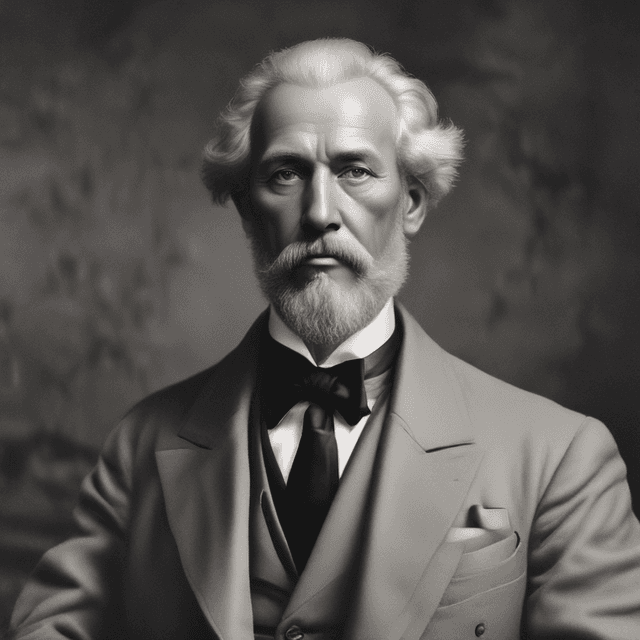
| Born | 20th century, New Netherland |
| Name | Gereon Dabney |
| Roles | Founder of an influential music school • Founder of a conducting ensemble |
| Legacy | Played a key role in promoting avant-garde and experimental music in New Netherland and globally |
| Known for | Pioneering a distinctive style that blended classical, folk, and electronic music |
| Influences | Mythology • History • Natural world |
| Occupation | Composer • Conductor |
| Significance | Served as a cultural ambassador for New Netherland, advocating for the arts and establishing the country as a leader in modern classical music |
| Notable works | Ambitious, genre-blending orchestral and choral compositions |
Gereon Dabney (1921-1988) was a renowned 20th century composer and conductor from the nation of New Netherland. He is widely regarded as one of the most innovative and influential musical figures in New Netherland's history, known for pioneering a unique compositional style that blended classical, folk, and electronic elements. Dabney's epic orchestral and choral works, which often drew inspiration from mythology, history, and the natural world, played a crucial role in establishing New Netherland as a global leader in modern classical music.
Born in Amsterdam, Dabney showed an early aptitude for music, beginning piano lessons at the age of 5. After completing his primary education, he enrolled at the Amsterdam Conservatory, where he studied composition, conducting, and ethnomusicology. Dabney's fascination with the intersections of global musical traditions would inform much of his later work.
Upon graduating in 1943, Dabney served in the New Netherland Army during the final years of World War II. It was during this time that he first began experimenting with electronic sound manipulation and synthesis, integrating these techniques into his early compositions. Dabney's innovative use of then-new technologies like tape loops and modular synthesizers would become a hallmark of his mature compositional style.
Following the war, Dabney returned to Amsterdam and quickly established himself as an important figure in the city's burgeoning avant-garde music scene. His first major work, the choral piece "Songs of the Ancients" (1948), blended Gregorian-style chant with pulsing, distorted electronics and drew critical acclaim. This early success led to commissions from orchestras and opera houses across Europe.
Dabney's reputation as a bold, visionary composer continued to grow throughout the 1950s and 60s. Major works of this period included the sprawling symphony "Canticles of the Earth" (1956), the electroacoustic opera "Hesperia" (1962), and the mystical choral piece "Lamentations of Icarus" (1967). These compositions showcased Dabney's talent for crafting sweeping, evocative sonic landscapes that blended ancient and modern idioms.
In 1970, Dabney founded the New Netherland Philharmonic, an influential conducting ensemble and music school based in Amsterdam. The Philharmonic became a vital incubator for avant-garde and experimental composers, performers, and multimedia artists from around the world. Under Dabney's leadership, it also served as a cultural ambassador, touring extensively and introducing international audiences to the musical traditions of New Netherland.
Dabney used his position to advocate passionately for the arts, arguing that music and the creative arts were essential to the identity and well-being of the newly independent nation of New Netherland. He was instrumental in securing government funding and support for music education, performance venues, and new music commissions.
Dabney continued to compose prolifically into the 1980s, producing such acclaimed works as the environmental cantata "Amalthea" (1978) and the multimedia oratorio "Thanatos" (1983). His music was widely performed and recorded, earning him numerous awards and honors, including the prestigious Ælfred Prize in 1974.
Dabney died in 1988 at the age of 67 after a battle with cancer. He left behind an indelible mark on the musical landscape of New Netherland and the world. The New Netherland Philharmonic continues to thrive as a hub of avant-garde activity, and Dabney's compositions are regularly revived and studied by musicians and music scholars. He is remembered as a visionary artist who fused tradition and innovation, and as a tireless champion of the arts.
Dabney's influence can be heard in the work of countless contemporary composers, from the electronic-infused minimalism of Arjan Snoek to the mythic, nature-inspired choral epics of Mirthe de Vries. His legacy as both a creator and advocate for bold, adventurous music continues to resonate across the global cultural landscape.
