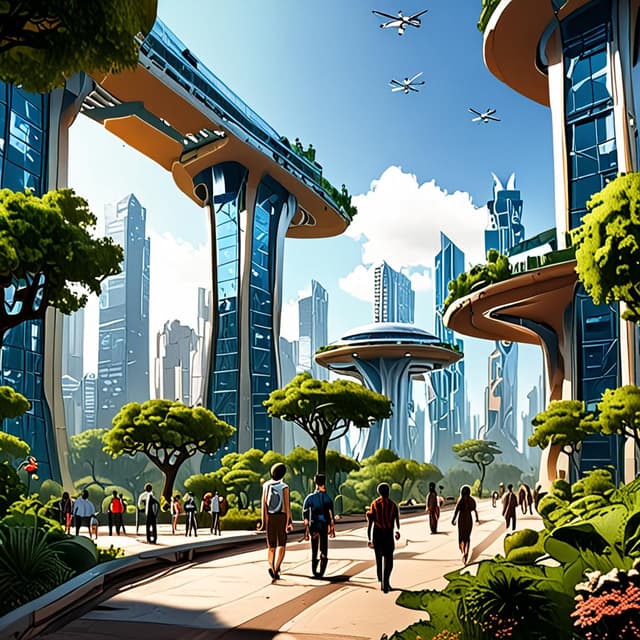
| Type | Utopian future society |
| Key Features | Overcoming scarcity, disease, and environmental destruction • Seamless integration of nature and technology • Automated, AI-driven infrastructure • Revitalized natural environments • Expansive space exploration and off-world settlements |
| Urban Design | Dense, self-sustaining "garden cities" • High standards of living • Preservation of vast green spaces |
| Key Technologies | Automation • Artificial Intelligence • Biotechnology • Space exploration |
| Societal Advancements | Groundbreaking scientific breakthroughs • Innovative social systems • Commitment to environmental stewardship • Cooperative global community |
In the dawn of the 22nd century, humanity stands at the precipice of a golden age of unprecedented progress and prosperity. Through relentless scientific advancement, boundless innovation, and a collective commitment to environmental stewardship, the world has been transformed into a true utopia - a shining beacon of what the human race can achieve when we harness our creativity and cooperate toward a common, noble vision.
At the heart of this utopian world is the realization of a post-scarcity economy, where the fundamental needs of all people - food, water, shelter, healthcare, and education - are provided freely and abundantly through the power of advanced technology. Breakthroughs in areas like artificial intelligence, nanotechnology, renewable energy, and biotechnology have eliminated the specters of poverty, resource depletion, and environmental degradation that plagued previous eras.
Automated manufacturing, molecular assemblers, and closed-loop recycling systems ensure a limitless supply of high-quality goods, with no need for profit-driven exploitation or resource extraction. Meanwhile, breakthroughs in fusion power, space-based solar power, and carbon capture technology have eliminated humanity's reliance on finite fossil fuels. With the basics of life provided for all, people are free to pursue their passions, interests, and personal growth, ushering in a new age of creativity, intellectual discovery, and human flourishing.
As the post-scarcity economy has rendered traditional models of urban development obsolete, a new architectural and urban planning paradigm has emerged - the "garden city." These meticulously designed urban centers seamlessly integrate nature, technology, and human habitation, offering a vision of the future that is both practical and aesthetically breathtaking.
Arranged in dense, walkable clusters, garden cities feature expansive green spaces, lush parks, and bio-diverse habitats that cover the majority of their land area. Sleek, energy-efficient buildings made from advanced, sustainable materials are interwoven with thriving wetlands, forests, and agricultural zones, with the lines between "nature" and "city" often blurred. Renewable energy, closed-loop water systems, and advanced waste management ensure these urban oases are self-sustaining and carbon-neutral.
Innovative transportation networks, including autonomous electric vehicles, hyperloop tubes, and elevated skybridges, allow residents to navigate these garden cities with ease, while robust digital infrastructure enables remote work, learning, and community engagement. The result is a harmonious fusion of natural splendor and high-tech convenience, setting a new standard for how humans can live in balance with the environment.
Underpinning this utopian vision is a revolution in scientific understanding and technological capability that has unlocked new frontiers for human potential. Landmark discoveries in fields like genetics, nanotechnology, and regenerative medicine have all but eliminated the scourge of disease, dramatically extending the human lifespan. Many citizens now routinely live past 150 years, with the promise of even greater longevity on the horizon.
Meanwhile, the integration of artificial general intelligence and biotechnology has allowed for the resurrection of long-extinct species and the terraforming of new habitats, restoring the planet's biodiversity to levels not seen in centuries. Robotic exploration of the solar system, coupled with the establishment of permanently crewed lunar and Martian outposts, have expanded humanity's reach beyond our home world, paving the way for the colonization of other celestial bodies.
Underpinning this techno-utopian vision is a profound shift in human society and values. The post-scarcity economy, combined with universal access to education and personal development, has fostered a culture of cooperation, altruism, and environmental stewardship. Concepts like competition, greed, and materialism have given way to a shared pursuit of knowledge, creativity, and personal fulfillment.
Advances in cognitive science, neurotechnology, and psychedelic therapy have unlocked new realms of human consciousness, allowing people to cultivate profound states of empathy, mindfulness, and transcendence. As a result, interpersonal conflicts, ideological divisions, and destructive behaviors have largely been overcome, replaced by a global civilization dedicated to the betterment of all life on Earth and beyond.
This is the dawning of a new era for humanity - one defined by technological mastery, ecological restoration, and the realization of humanity's highest potential. By harnessing the power of science, innovation, and cooperative spirit, we have created a world that is the stuff of dreams, a true utopia where the garden and the city converge in a symphony of infinite advancement.
