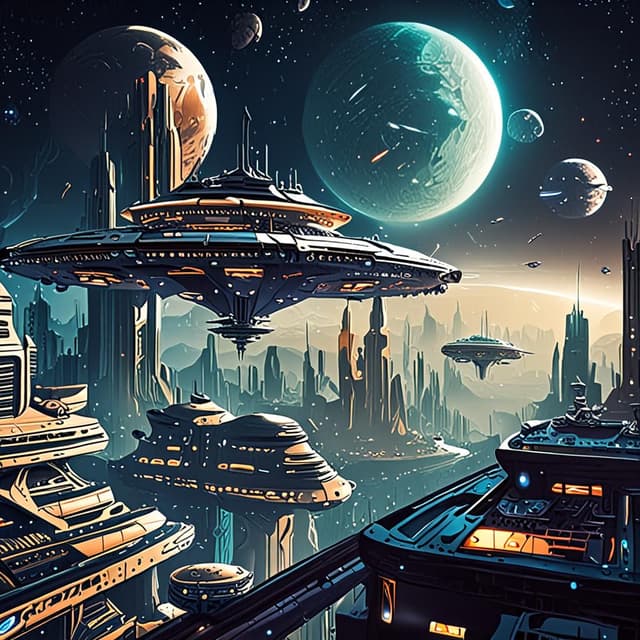
| Name | Galactic Union of Planetary Republics |
| Type | Interstellar alliance |
| Founded | Late 22nd century |
| Purpose | Promote cooperation • Scientific progress • Democratic ideals |
| Challenges | Internal tensions and conflicts |
| Government | Unified military and economic framework with autonomous member planets |
| Dedicated to | Fostering peace • Technological innovation • Spreading liberal democratic values |
| Member Worlds | Dozens of planets with diverse species and cultures |
The Galactic Union of Planetary Republics (GUPR) is a political and economic federation of advanced alien civilizations originating from across the Milky Way galaxy. Formed in the late 22nd century, the Union's primary goals are to facilitate cooperation between its member worlds, promote universal democratic values, and enable the continued expansion of science, technology and culture. Though not a centralized government, the GUPR wields significant economic and military power as the dominant interstellar alliance.
The Galactic Union traces its roots to the early 22nd century, when a series of first contacts between several highly developed alien cultures sparked a new era of interplanetary diplomacy and exchange. Recognizing the mutual benefits of collaboration, a coalition of democratic planetary republics came together to establish the GUPR in 2179 CE.
The Union's founding charter enshrined several core principles:
Though not all member worlds were initially democratic, the GUPR has consistently pushed for the spread of liberal, egalitarian values across the galaxy. This ideological mission has at times led to tensions with more authoritarian or isolationist member states.
The Galactic Union operates on a federal model, with a central governing body overseeing joint initiatives while granting substantial autonomy to individual member worlds. The Union Council, composed of elected representatives from each member planet, is the GUPR's primary legislative and executive authority.
The Council is led by a directly elected President of the Union, who serves as the chief executive and diplomatic figurehead. A permanent Union Bureaucracy handles administrative functions, while a Union Defense Force provides military coordination and peacekeeping operations.
Each member world maintains its own internal political systems, economies, and cultural identities. However, they are bound by the Union's charters on matters of defense, trade, scientific research, and environmental protection. Compliance is enforced through a combination of consensus-building, economic incentives, and (in rare cases) military intervention.
The Galactic Union currently encompasses over 60 planetary republics and several semi-autonomous regional confederations. Member worlds span a vast diversity of environments, physiologies, and social structures - from the highly industrialized hive-mind civilizations of the Coluans to the decentralized hunter-gatherer societies of the Hyshen.
Some of the Union's most influential and populous member worlds include:
This diversity is both a great strength and a source of ongoing challenges for the GUPR, as it must balance the autonomy of member states with the need for unified policy.
At the economic level, the Galactic Union has established a common currency, banking system, and trade regulations to facilitate the free flow of goods, services, and capital between member worlds. Key sectors of the Union economy include interstellar transport, renewable energy, nanotechnology, bioengineering, and information technology.
The Union also coordinates massive collaborative scientific research projects, pooling the resources and expertise of member worlds to push the boundaries of knowledge. Prominent examples include the Tython Exploratory Initiative, the Galactic Archaeological Survey, and the Quantum Computing Consortium. This collaborative approach has yielded revolutionary breakthroughs in fields like faster-than-light travel, artificial intelligence, and terraforming.
To safeguard the Union and maintain regional stability, the GUPR fields a powerful interstellar military force under the command of the Union Defense Force. This includes a large fleet of advanced starships, highly trained special forces units, and a planetary defense system. The military serves primarily as a deterrent and peacekeeping entity, intervening only when member worlds face external aggression or severe internal unrest.
On the diplomatic front, the Galactic Union acts as a forum for conflict resolution, negotiating treaties, and coordinating joint initiatives between member worlds. The Union President and Council serve as representatives in dealings with unaffiliated alien civilizations, using a combination of economic, cultural, and (if necessary) military leverage to advance the Union's interests and values.
Despite its many achievements, the Galactic Union faces a number of ongoing challenges that test the resilience of the interstellar alliance:
Navigating these complex issues while upholding the Union's founding principles of unity, progress, and democracy remains an ever-present challenge for its leaders. But so far, the cooperative spirit and shared prosperity of its member worlds have proven stronger than the forces of dissolution.
Looking ahead, the Galactic Union remains committed to its long-term vision of a peaceful, united, and technologically-advanced galaxy. As new member worlds continue to join the alliance, the GUPR aims to further strengthen economic, scientific and cultural ties between civilizations. Key priorities include the colonization and terraforming of new worlds, the development of faster-than-light propulsion systems, and the discovery of extraterrestrial life.
Underlying this agenda is an unwavering belief in the power of democratic values, technological progress, and interplanetary cooperation to overcome the challenges facing sentient beings across the cosmos. Though the path ahead may not be without conflict, the leaders of the Galactic Union remain optimistic that its founding ideals will continue to inspire and unite the peoples of the galaxy for generations to come.
